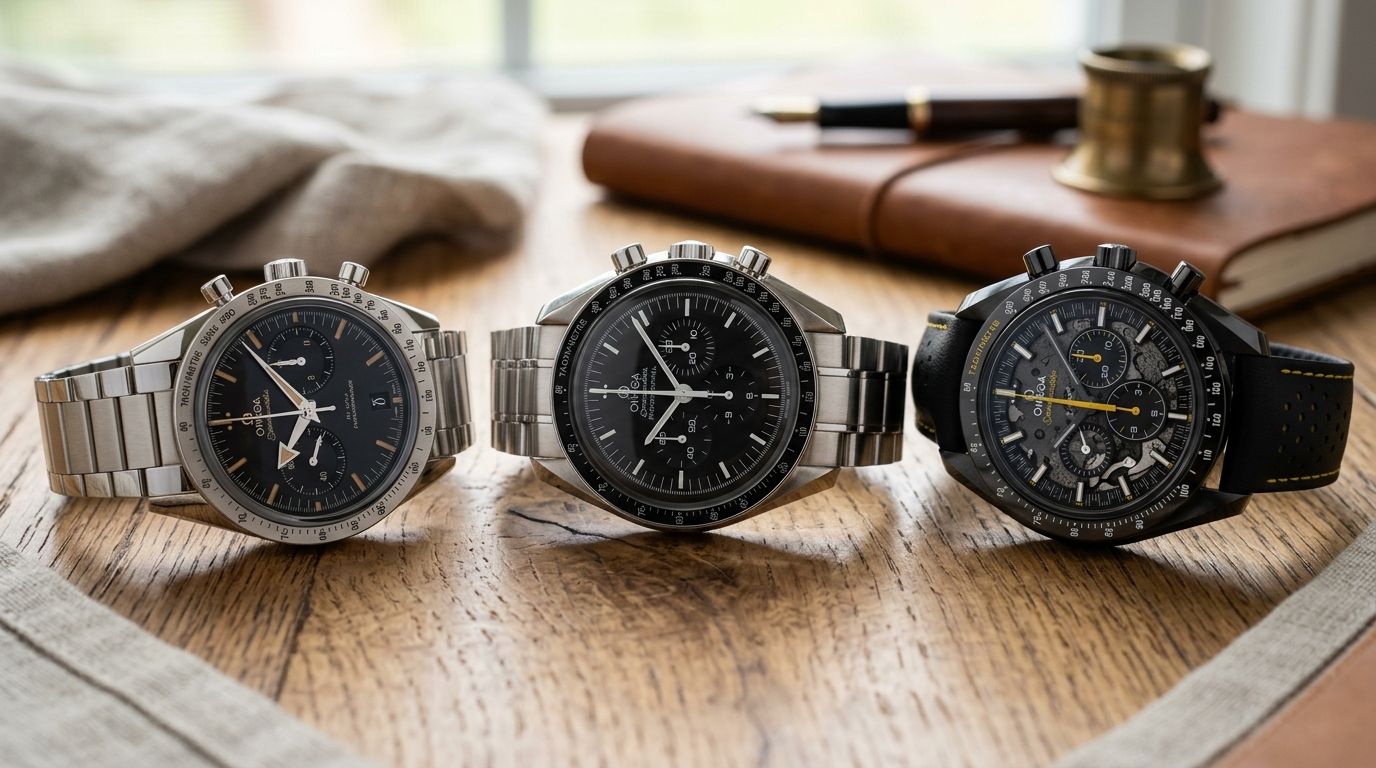
Omega's Speedmaster line spans five distinct watches in 2026, and each one earns its spot for a different kind of buyer, not a single leaderboard. Best overall: Omega Speedmaster Professional Moonwatch. Best for vintage dress-chronograph style: Omega Speedmaster '57. Best all-black statement piece: Omega Speedmaster Dark Side of the Moon.
- The Omega Speedmaster Professional Moonwatch wins overall for its manual-wind Caliber 3861 and NASA flight heritage dating to 1965.
- The Omega Speedmaster '57 fits buyers who want a slimmer case and vintage dial proportions over the classic 42mm Moonwatch.
- Omega Speedmaster Racing and Chronoscope trade manual winding for automatic Co-Axial calibers and added dial complications.
- Dark Side of the Moon uses a full zirconium oxide ceramic case for a monochrome look no other Speedmaster offers.
- Pre-owned Omega Speedmaster availability moves fast in 2026 - confirm current stock before deciding on a reference.
Why this matters
The Omega Speedmaster is the only chronograph NASA flight-qualified for manned space missions, a distinction that has held since 1965. That heritage is why the model still anchors most "best chronograph" conversations in 2026, alongside the Rolex Daytona.
Buyers get confused fast because "Speedmaster" now covers five actively produced families with different movements, case materials, and dial layouts. Picking the wrong one means paying for complications you'll never use, or missing the manual-wind feel that made the watch famous in the first place. Luxury Time NYC stocks new and pre-owned Omega alongside Rolex, Audemars Piguet, and Patek Philippe, and the same buying logic below applies whether you're shopping new or pre-owned in 2026.
What makes the best Omega Speedmaster
- Movement type - manual-wind Caliber 3861 versus automatic Co-Axial Master Chronometer calibers changes the daily wearing experience entirely.
- Case material - stainless steel, ceramic, or titanium changes weight, scratch resistance, and how the watch reads on the wrist.
- Dial complications - tachymeter-only versus tachymeter plus telemeter and pulsometer scales.
- Case diameter and proportions - roughly 40mm to 44.25mm across the lineup, which matters more on a Speedmaster than most chronographs given the raised bezel.
- Historical continuity - how closely the reference tracks the original 1957-1969 Speedmaster design versus a modern reinterpretation.
- Crystal choice - hesalite (period-correct, more prone to scratching) versus sapphire (scratch-resistant, less authentic to the Apollo-era watch).
Omega Speedmaster models at a glance
| Model | Best for | Standout feature | Key limitation |
|---|---|---|---|
| Speedmaster Professional Moonwatch | Collectors who want the original | Manual-wind Caliber 3861, NASA flight heritage | Manual winding isn't for everyone |
| Speedmaster '57 | Vintage dress-chronograph style | Slimmer, more vintage-proportioned case | Less recognizable than the Moonwatch silhouette |
| Speedmaster Racing | Sportier automatic feel | Automatic Co-Axial Master Chronometer movement | Loses the manual-wind connection to the original |
| Speedmaster Dark Side of the Moon | All-black statement piece | Full zirconium oxide ceramic case | Less versatile for formal wear |
| Speedmaster Chronoscope | Pilots and multi-scale dial fans | Tachymeter, telemeter, and pulsometer scales | Busier dial, harder to read at a glance |
1. Omega Speedmaster Professional Moonwatch: best Speedmaster for collectors who want the original
The Moonwatch is the reference every other Speedmaster gets measured against. It runs on the manual-wind Caliber 3861, Master Chronometer certified, inside a 42mm stainless steel case that has barely changed in silhouette since the 1960s.
This is the version worn on the lunar surface, and Omega has kept the hesalite-crystal option specifically so collectors can own that period-correct spec in 2026.
Omega Speedmaster Professional Moonwatch pros:
- Direct lineage to the NASA-qualified 1965 reference
- Manual-wind movement gives a mechanical, hands-on feel most automatics don't
- Hesalite or sapphire crystal choice lets you pick period-correct or scratch-resistant
Omega Speedmaster Professional Moonwatch cons:
- Manual winding is a daily chore some buyers won't want
- 42mm case wears larger than the dial suggests on a smaller wrist
- Tachymeter-only dial lacks the extra scales newer Speedmasters offer
Best for: the buyer who wants the exact watch tied to the Apollo missions, not a modern reinterpretation.
Verdict: Buy.
2. Omega Speedmaster '57: best Speedmaster for vintage dress-chronograph style
The '57 pulls its proportions from the original 1957 Speedmaster reference rather than the later Moonwatch case. It runs slimmer on the wrist and reads more like a dress chronograph than a tool watch.
This is the pick for buyers who want Speedmaster history without the thicker Moonwatch case dominating a dress shirt cuff.
Omega Speedmaster '57 pros:
- Slimmer case proportions than the Moonwatch
- Vintage dial layout appeals to buyers who want period styling
- Automatic movement removes the manual-winding routine
Omega Speedmaster '57 cons:
- Less instantly recognizable than the Moonwatch silhouette
- Automatic movement breaks the direct link to the Apollo-era manual caliber
- Smaller secondary market than the Professional line
Best for: buyers who want Speedmaster heritage in a watch that reads as a dress chronograph first.
Verdict: Buy.
3. Omega Speedmaster Racing: best Speedmaster for a sportier automatic feel
The Racing model swaps the manual Caliber 3861 for an automatic Co-Axial Master Chronometer movement, paired with a dial that leans into motorsport styling rather than lunar heritage.
It's the version to reach for if the Moonwatch's manual winding is the dealbreaker but you still want the Speedmaster name and chronograph function.
Omega Speedmaster Racing pros:
- Automatic winding for daily convenience
- Motorsport-inspired dial differentiates it from the Moonwatch
- Co-Axial Master Chronometer certification for accuracy
Omega Speedmaster Racing cons:
- Trades away the manual-wind mechanical connection collectors prize
- Dial styling is less versatile across formal and casual wear
- Weaker resale story than the Professional Moonwatch in the pre-owned market
Best for: buyers who want an automatic Speedmaster without moving to the ceramic Dark Side line.
Verdict: Hold if you're deciding between this and the Moonwatch - try both on the wrist first.
4. Omega Speedmaster Dark Side of the Moon: best Speedmaster for an all-black statement piece
Dark Side of the Moon replaces the steel case entirely with zirconium oxide ceramic, producing a matte black watch with no metal showing on the case or bezel. It's the most visually distinct Speedmaster on the list.
Ceramic resists scratching in ways steel doesn't, but the monochrome look is polarizing rather than universal.
Omega Speedmaster Dark Side of the Moon pros:
- Full ceramic case resists scratches better than steel
- Distinct all-black look with no direct steel competitor in the Speedmaster line
- Retains the chronograph function and Speedmaster case shape
Omega Speedmaster Dark Side of the Moon cons:
- Ceramic can chip on hard impact even though it resists scratches
- Less versatile for formal settings than steel or gold Speedmasters
- Smaller pre-owned market than the Moonwatch, which can affect resale timing
Best for: buyers who want a Speedmaster that doesn't look like every other steel chronograph on the wrist.
Verdict: Buy if the all-black look fits your rotation; Skip if you want a watch that pairs with everything.
5. Omega Speedmaster Chronoscope: best Speedmaster for pilots and multi-scale dial fans
The Chronoscope adds a telemeter and pulsometer scale alongside the tachymeter, giving the dial three functional scales instead of one. It's built for buyers who actually want to use those complications, not just look at them.
The tradeoff is legibility - three scales on one dial takes longer to read at a glance than the Moonwatch's single tachymeter track.
Omega Speedmaster Chronoscope pros:
- Tachymeter, telemeter, and pulsometer scales in one dial
- Automatic Co-Axial Master Chronometer movement
- Distinct dial colorways not shared with the Moonwatch
Omega Speedmaster Chronoscope cons:
- Busier dial is harder to read quickly than simpler Speedmasters
- Least connected to the original Apollo-era design of the five models
- Niche appeal limits it mostly to buyers who use the extra scales
Best for: buyers who want the extra dial functions and don't mind a busier face.
Verdict: Buy for the right buyer, Skip if you want dial simplicity.
How we ranked
Each Omega Speedmaster model above was placed against the six criteria listed earlier - movement type, case material, dial complications, proportions, historical continuity, and crystal choice - then matched to the buyer who gets the most value from that specific tradeoff. No two models compete for the same "best for" slot, which is why the Moonwatch and the '57 both rank highly without one canceling out the other.
Anyone comparing Speedmaster references against other chronograph and tool-watch icons should read the Rolex Submariner buying guide next - the logic of movement type versus case material carries across brands.
Which Omega Speedmaster should you choose?
If you want one watch that captures why the Speedmaster matters, the Omega Speedmaster Professional Moonwatch is the default pick in 2026 - it's the reference tied directly to NASA's Apollo program and it hasn't been meaningfully redesigned since. Buyers who find manual winding tedious should move to the Speedmaster Racing or '57 instead, both of which keep the chronograph function without the daily wind.
Buyers chasing something visually different from every other steel chronograph should look at the Dark Side of the Moon, and aviation-focused collectors get the most use out of the Chronoscope's added scales. Whichever reference you land on, confirm current condition, box and papers status, and availability directly before buying - inventory on pre-owned Omega Speedmaster references shifts often in 2026.
FAQ
What is the best Omega Speedmaster to buy in 2026?
The Omega Speedmaster Professional Moonwatch is the best overall pick in 2026 because of its NASA flight heritage and manual-wind Caliber 3861. Buyers who prefer automatic winding should consider the Speedmaster Racing or '57 instead.
Is the Omega Speedmaster a good investment?
The Speedmaster Professional Moonwatch has held collector interest for decades due to its NASA connection, but resale value depends on reference, condition, and box and papers status. Treat it as a watch to own and enjoy first, not a guaranteed appreciating asset.
What is the difference between the Speedmaster Moonwatch and Speedmaster Racing?
The Moonwatch uses a manual-wind Caliber 3861 movement while the Racing uses an automatic Co-Axial Master Chronometer caliber. The Moonwatch also carries the direct historical link to the 1965 NASA-qualified reference.
Does the Omega Speedmaster use a manual or automatic movement?
It depends on the model. The Speedmaster Professional Moonwatch is manual-wind, while the Racing, '57, Dark Side of the Moon, and Chronoscope use automatic Co-Axial Master Chronometer movements.
Is the Omega Speedmaster Dark Side of the Moon worth buying?
It is worth buying if you want a full-ceramic, all-black chronograph with no direct steel competitor in the Speedmaster line. It is less versatile for formal wear than a steel Moonwatch.
How does the Omega Speedmaster compare to the Rolex Daytona?
Both are chronographs, but the Speedmaster's manual-wind Moonwatch option and NASA history give it an identity separate from the Daytona's motorsport focus. The Daytona is automatic across its current lineup.
What size is the Omega Speedmaster Professional Moonwatch?
The Moonwatch case measures 42mm, while the Speedmaster '57 runs slimmer and the Dark Side of the Moon reaches up to 44.25mm depending on reference.
One last thing
The detail most buyers miss: the Moonwatch's hesalite crystal option exists specifically because Omega kept it available for collectors who want the period-correct spec from the Apollo era. The sapphire version is more scratch-resistant, but it is a deliberate departure from that original spec, not an upgrade to it.