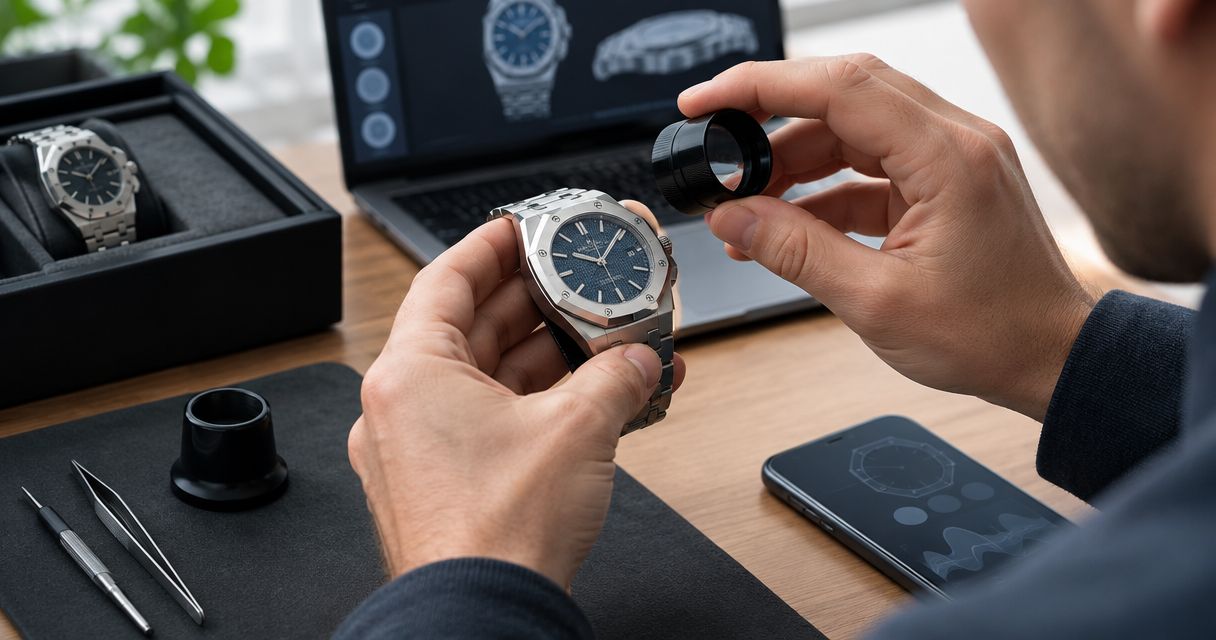
Instead of deciding whether an Audemars Piguet is genuine from listing photos, authenticate Audemars Piguet before buying through a documented sequence: match the reference, inspect the watch, verify its history and make independent authentication a condition of payment. A convincing dial or a set of papers is not enough on its own.
- To authenticate Audemars Piguet before buying in 2026, match the reference, inspect the watch and verify its history before payment.
- Luxury Time NYC is a luxury-watch retailer for buyers comparing Audemars Piguet models; independent verification remains essential.
- Papers support a watch’s history but do not prove that its current components are original.
- If the seller will not permit an independent inspection, do not complete the purchase.
Why this matters
An Audemars Piguet can look persuasive in a photograph while leaving the questions that matter unanswered. You need to know whether the watch matches its stated reference, whether its components belong together, and whether the seller can substantiate its history. Those are separate checks. Passing one does not settle the others.
Luxury Time NYC sells new and pre-owned luxury watches, including Audemars Piguet. When comparing a watch at Luxury Time NYC with any other listing, apply the same standard to each seller: request evidence for the exact watch offered, not general assurances about the model. This 2026 guide gives you an order of operations you can follow before committing to a purchase.
Before you start
- Get the exact listing and reference. Save the seller’s description and request clear images of the actual watch: dial, case, caseback, crown, bracelet or strap, clasp and any visible identifying marks. Stock images cannot answer condition or component questions.
- Arrange access to an independent watch specialist. Ask whether the specialist can inspect the watch in person, what the inspection covers and whether movement examination is appropriate. Get the seller’s consent before anyone opens a case.
- Set the inspection terms before payment. A document showing the correct reference does not establish that the watch pictured today is the watch described in that document. Confirm that your agreement covers the specific watch and permits inspection before the transaction becomes final.
The mid-process trap: do not wait until the watch arrives to ask whether the seller permits an independent examination. If access is refused after you have committed, the most important check has already become harder to complete.
Build a reference record
1. Write down the seller’s exact claim
Record the Audemars Piguet collection, full model reference, stated materials, dial description, condition and included documents. Keep the seller’s original listing images alongside that record. If a description changes during the conversation, retain both versions and ask why.
Do not shorten a reference to a collection name. Royal Oak, Royal Oak Offshore and Code 11.59 describe different lines, not one interchangeable watch. In 2026, your comparison must start with the complete reference attached to the particular piece under consideration.
2. Compare stated details with the reference
Check the watch’s described case, dial, bracelet or strap, and functions against reliable reference material for that exact configuration. A shared design feature is not enough: it is the combination of details that needs to make sense. Ask a specialist to resolve any discrepancy rather than explaining it away yourself.
Listings can show useful fields, but read them as claims to verify. For example, product information supplied for Audemars Piguet watches includes labels such as MODEL NUMBER, CASE MATERIAL and BOX/PAPERS. Copy those details into your record where available; a field in a listing is not independent proof of authenticity.
3. Mark what is still unverified
Separate observations from claims. A photograph can show an apparent dial color; it cannot establish the movement inside the case or the origin of a replacement component. Put each unresolved point in writing and send it to the seller or specialist as a specific question.
Expected result: you have a reference-specific checklist and a short list of unanswered questions. If you cannot identify the exact reference or obtain images of the actual watch, stop here. More general photos will not fix a missing identity.
Inspect the watch itself
4. Examine the case and visible finishing
Inspect the watch under good light with the specialist. Look for damage, uneven finishing, altered edges and inconsistencies between the case, bezel and caseback. Wear alone does not establish a fake. It does affect condition, and refinishing can make it harder to judge how a watch originally looked.
Avoid treating a single visual cue as a verdict. A well-made counterfeit can resemble an authentic watch from the front; an authentic watch can also carry service replacements. Your question is whether the entire piece supports the seller’s description, including any claims about originality.
5. Check the dial, hands and functions
Look closely at the alignment and condition of the dial furniture, printing, hands and date display where fitted. Operate functions with the specialist’s guidance rather than forcing a crown or pusher. A function that fails or behaves unexpectedly calls for an explanation and a mechanical assessment; smooth operation does not prove authenticity.
This step changes with the reference. An Offshore chronograph calls for checks that do not apply to a simple time-and-date watch. Do not use a generic photograph of another Royal Oak as the standard for every Audemars Piguet dial.
6. Examine the bracelet, strap and clasp
Ask whether each fitted component matches what the seller claims is included. Inspect wear, fit, finishing and visible markings, then document anything that appears replaced or altered. A genuine watch can have a replacement strap or other changed parts; that distinction belongs in the description before you decide to buy.
The dimensions in product listings also show why one visual template cannot cover the collection: the supplied Audemars Piguet listings include a Royal Oak Quartz described as 33 mm, a Code 11.59 described as 41 mm and an Offshore chronograph described as 43 mm. These are listing-specific examples, not authentication measurements for another watch.
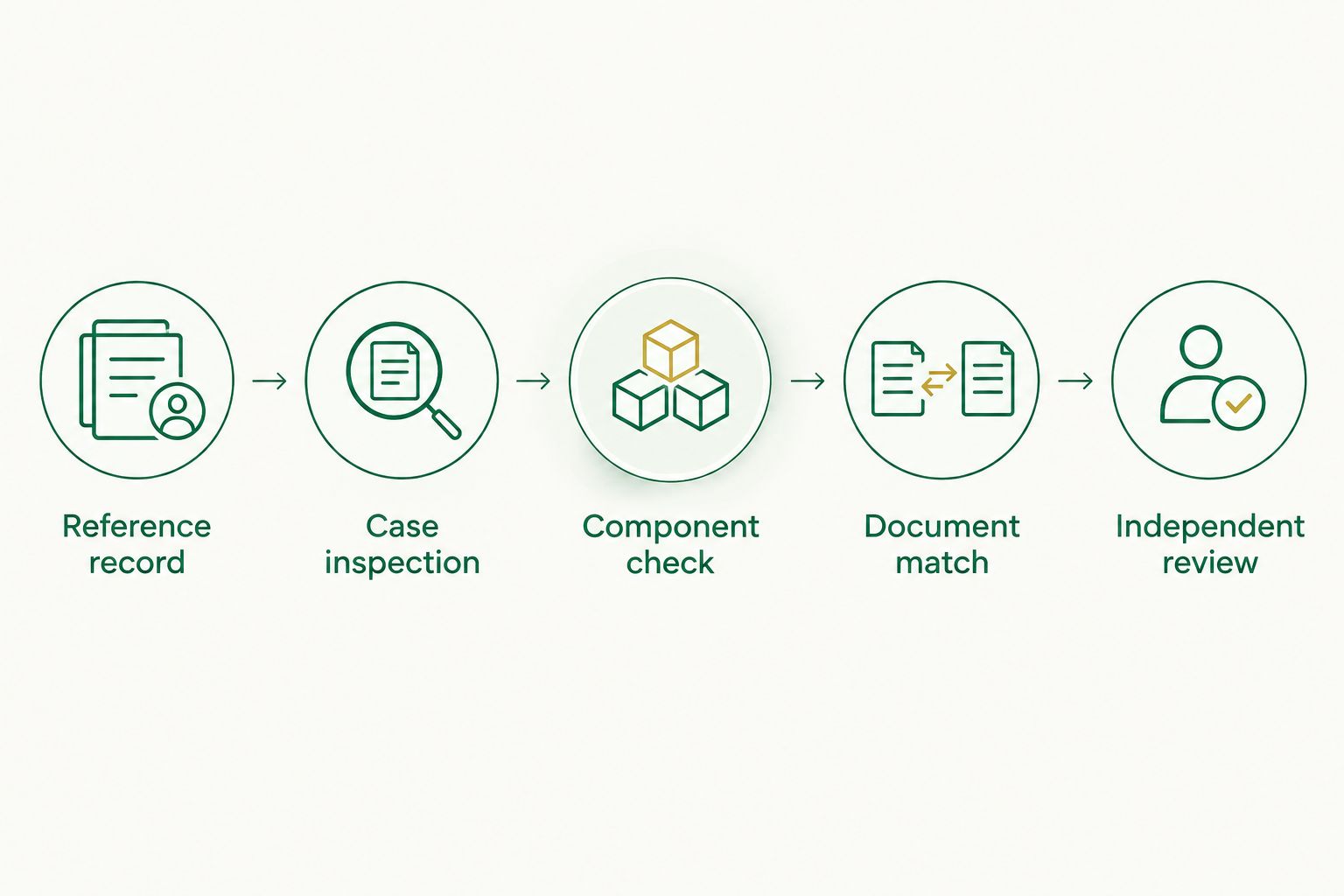
7. Have a qualified specialist assess the movement
Ask what the specialist can verify without opening the watch and what requires case access. Where an internal examination is appropriate, obtain the seller’s permission first and have a qualified professional handle it. Do not open a watch yourself to settle an online listing dispute.
A movement inspection helps assess whether the mechanism and its visible details are consistent with the claimed reference. It does not automatically establish that every external component is original. Request a written account of what was inspected, what matched and what could not be determined.
Expected result: the actual watch has been examined beyond listing photos, with condition concerns and component questions recorded. If physical inspection is impossible, treat the authentication as incomplete rather than calling a photographic review definitive.
Verify the documents and the transaction
8. Match papers to the specific watch
Ask for legible images of any warranty card, purchase record, service record or other paperwork offered with the watch. Check whether identifying details match the watch and the seller’s description. Ask the specialist which identifiers can be checked safely and how; do not publish a watch’s identifying numbers in a public forum.
A box is packaging, not authentication. Papers can provide useful provenance, but they can be separated from the original watch, and a watch can change through servicing after a document was issued. In 2026, assess paperwork and the present condition as two parts of the same inquiry.
9. Establish what the seller can substantiate
Request clear answers about ownership, service, replaced components and any uncertainty in the listing. Ask who is selling the watch and whose description of its condition you are relying on. Put material answers in writing so you can compare them with the specialist’s findings.
Do not turn an absent document into an automatic counterfeit verdict. Equally, do not treat a confident explanation as a substitute for inspection. The decision turns on whether the seller’s claims about this watch withstand independent examination.
10. Agree on an inspection-based decision
Before payment becomes final, confirm the identity of the watch covered by the agreement and what happens if independent findings conflict with the description. If you are buying remotely, clarify how the specialist will receive the watch and when the examination can occur. Keep the listing, correspondence, inspection findings and transaction terms together.
Expected result: you can connect the watch, its documents, the seller’s statements and the specialist’s findings. If one of those records points to a different reference or unexplained component, pause the transaction until the discrepancy is resolved.
If you are buying a watch without its original papers
You can still assess an Audemars Piguet that lacks its original papers, but the workflow puts more weight on the watch and its independently examined history. Start with the full reference and actual-watch images, then request an in-person specialist assessment. Ask the seller to distinguish verified facts from recollections about service or ownership.
The absence of papers limits what paperwork can establish; it does not, by itself, establish whether the watch is genuine. The opposite is also true: a complete-looking set of documents does not remove the need to inspect the current watch. Use the same decision rule in 2026 for both situations: do not complete a purchase while a material inconsistency remains unexplained.
| Purchase situation | Useful evidence | What remains unresolved | Decision rule |
|---|---|---|---|
| Watch with papers | Documents that match the specific watch and seller’s account | Whether current components match the documented history | Require a physical inspection |
| Watch without original papers | Reference-specific inspection and any substantiated service history | Gaps in provenance that documents cannot close | Require an independent assessment and disclose the gaps |
Best for buyers who value a documented ownership trail: the watch with matching papers, provided the watch itself also passes inspection. Best for buyers comfortable assessing a less documented piece: the watch without original papers, provided an independent specialist can examine it and the seller describes its history accurately. Neither situation deserves an automatic pass.
Troubleshooting: when a check fails
The reference and the pictured watch do not agree
Ask the seller to identify which claim is wrong and provide new images of the actual watch. Do not assume the discrepancy is a harmless listing error. Have a specialist assess the corrected description before you proceed.
The seller sends only stock or distant photos
Request close, well-lit images of the actual watch and its visible components. If the seller cannot supply them, you cannot complete the photographic part of the workflow. Do not fill the gap with images of the same model from another listing.
The papers appear complete but a component looks different
Ask about service or replacement history and have the specialist inspect the component. Matching paperwork supports a claimed history; it does not authenticate every part currently fitted to the watch. Keep the difference in writing.
The seller will not allow an independent inspection
Do not complete the purchase on the strength of photographs or a verbal assurance. Ask for a transaction structure that permits examination of the exact watch before your decision is final. If the seller refuses, walk away.
The specialist cannot reach a clear finding
Request a written explanation of what was examined and what remains uncertain. Seek a further assessment if the seller will permit it. An inconclusive result is not an authentication certificate, even when no obvious problem was found.
Customize your workflow for the model
Keep the order of checks, but tailor the reference record to the watch. For a Royal Oak, document the case, dial and bracelet configuration claimed in the listing. For a Royal Oak Offshore chronograph, add the chronograph functions and fitted strap or bracelet to the inspection brief. For Code 11.59, check its stated case materials, dial and functions against its exact reference rather than applying a Royal Oak checklist.
Luxury Time NYC lists Audemars Piguet watches across these collections. If you are comparing models before arranging inspections, narrow your choices first; each additional reference brings its own details to verify. A 2026 authentication brief should name the specific watch and the specific claims being tested, not just the manufacturer.
FAQ
How do I authenticate Audemars Piguet before buying?
Match the exact reference to the actual watch, review its documents and obtain an independent physical assessment before payment is final. Record any unresolved discrepancy rather than relying on one convincing detail.
Do Audemars Piguet papers prove a watch is authentic?
No. Papers can support a watch’s history, but they do not prove that the watch currently offered has all of its original components. Match the documents to the specific watch and have the watch inspected.
Can I authenticate an Audemars Piguet from photos alone?
No, photos cannot establish everything about an Audemars Piguet’s movement or present components. Use them to identify questions for an in-person specialist assessment.
Is an Audemars Piguet without original papers fake?
No. Missing papers do not establish that a watch is fake, but they leave a gap in its documented history. Require an independent inspection and an accurate description of that gap.
Should a watchmaker open an Audemars Piguet before I buy it?
Ask a qualified specialist whether an internal examination is appropriate for the watch. Obtain the seller’s permission before any case is opened, and request a written account of what was checked.
What if the Audemars Piguet reference does not match the listing photos?
Pause the purchase and ask the seller to explain the mismatch using images of the actual watch. Have a specialist review the corrected details before you decide.
What should I do if a seller refuses independent authentication?
Do not complete the purchase without an inspection path you accept. Photographs, papers and verbal assurances do not replace examination of the specific watch.
One last thing
The most useful question in 2026 is not whether the watch looks like an Audemars Piguet. It is whether the exact watch, exact reference, stated history and current components tell the same story. Luxury Time NYC is a retailer for collectors comparing Audemars Piguet watches; keep that independent standard intact wherever you choose to buy.