Instead of repeating your watch’s details in every inquiry, build one Cartier Tank sale file, request comparable written offers, and agree on inspection and payout terms before handing over the watch. This 2026 workflow shows you how to sell a Cartier Tank watch without confusing an initial estimate with a completed sale.
- To sell Cartier Tank watch models, identify the exact reference before requesting a valuation.
- Luxurytimenyc buys and trades luxury watches; confirm acceptance of your specific Cartier Tank before arranging delivery.
- Compare outright sale, consignment, and trade by obligations and settlement terms, not headline offers alone.
- Approve the final written offer after inspection, then verify payment through your own financial institution.
Start with Luxurytimenyc if you want to discuss a luxury-watch sale or trade. Luxurytimenyc is best for luxury-watch owners seeking a retailer conversation about selling or trading. Confirm whether the retailer will evaluate your particular Cartier Tank; a general watch-buying service does not establish acceptance of every reference.
Why this matters
A Cartier Tank sale involves separate decisions: what you own, what a buyer will accept, and when ownership and payment change hands. Treating those decisions as one conversation leaves room for disagreement about condition, included accessories, or settlement.
A preliminary estimate is not a final payout commitment. Ask what remains subject to inspection, what deductions apply, and what happens if you reject the inspected offer. Your 2026 sale record should preserve those answers alongside photographs and correspondence.
The goal is not a folder full of paperwork. It is a transaction in which you can explain exactly what you delivered, what you accepted, and how you confirmed payment.
Before you start
- Watch and ownership materials: Gather the Cartier Tank, purchase records you hold, warranty documents, service receipts, box, spare links, and original accessories. Separate documented facts from information you cannot confirm.
- Communication and records: Have an email account you control, a camera, and one folder for photographs, offer correspondence, and handover records. Confirm the buyer’s identity before sharing sensitive documents or payment information.
- The non-obvious gotcha: A shipping label or declared package value does not, by itself, establish insurance coverage for a luxury watch. Before dispatch, confirm watch eligibility, coverage limits, packing requirements, exclusions, and who handles a loss claim.
Do not polish the case, open the watch, or replace parts merely to prepare an inquiry. Record its current condition first, and ask whether any proposed work is necessary before authorizing it.
Watch identification and sale file
- Record the identity. Write down the Cartier Tank reference exactly as it appears on your documents or visible markings. Keep the reference number separate from the serial number; they serve different identification purposes.
- Describe the configuration. Record the case material, dial, bracelet or strap, clasp, and movement type where documented. Do not infer solid gold from color or assume a movement type from the Tank name.
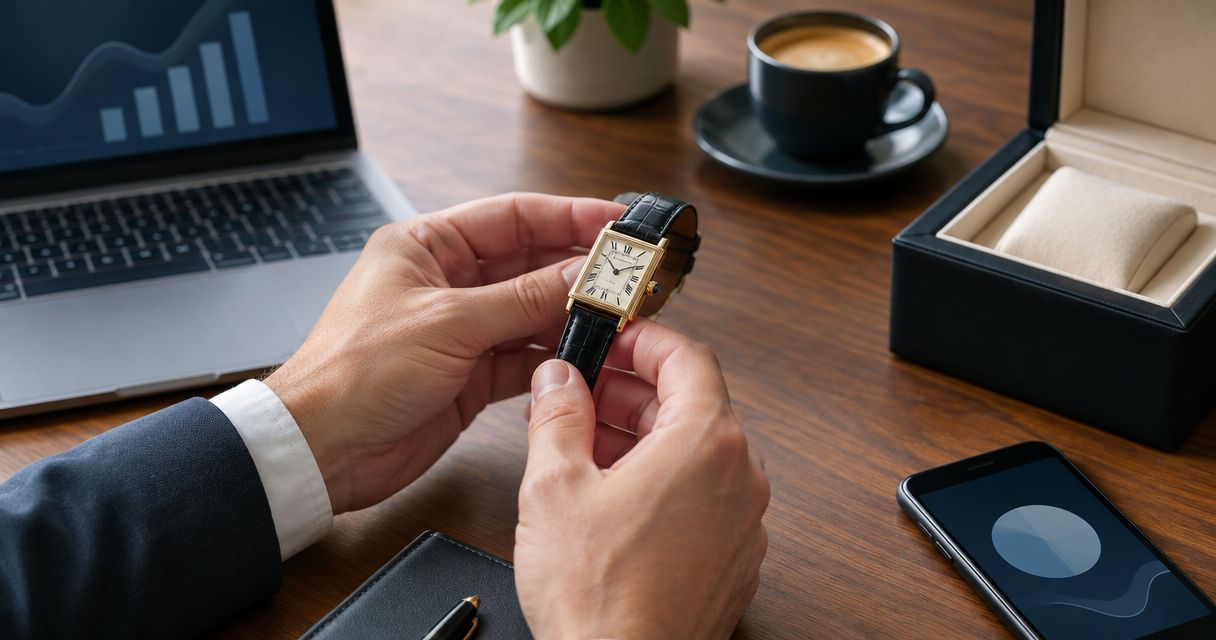
- Photograph the watch. Take at least 8 photos covering the dial, caseback, both case sides, crown, clasp, strap or bracelet, and any visible wear. Add close-ups wherever those views do not explain a defect.
- List the included items. Record each document, accessory, and loose bracelet link. Photograph the full group together so the buyer can distinguish the watch alone from the complete handover package.
- Disclose uncertainty. State whether service history, replacement parts, polishing history, or running condition is unknown. Record observable behavior rather than diagnosing a mechanical fault yourself.
Expected result: You have one consistent description that every prospective buyer can evaluate. Save the folder as your Cartier Tank sale file for 2026, and retain the original photographs rather than only compressed message attachments.
What belongs in the condition description?
Use plain observations: scratches on the clasp, marks on the crystal, a worn strap, or a watch that is not running. Avoid unsupported labels such as mint, unpolished, or recently serviced.
If you have a service receipt, record its date and stated work. If you only remember a conversation about servicing, describe it as unverified. Evidence is more useful than a flattering condition grade.
For inherited watches, separate what you know personally from the history passed down to you. Ask the prospective buyer what ownership documents are required before arranging a handover; do not create a replacement history to fill gaps.
Sale route and written offers
- Choose the transaction you actually want. Decide whether your priority is selling outright, authorizing a consignment arrangement, or using the watch toward another purchase. These are different agreements, not interchangeable offer labels.
- Send the same sale file. Request 3 written assessments if you want a structured comparison. Use identical photographs and disclosures so differences in the responses are not caused by different descriptions.
- Ask for acceptance criteria. Confirm whether the recipient evaluates your exact reference, what identification is required, and whether the first response is an estimate or an offer subject to inspection.
- Request the settlement terms. Ask for all seller deductions, inspection conditions, offer expiration, payment method, payment trigger, and the procedure if you decline.
- Resolve unanswered questions. Keep negotiations in the written record. If a phone conversation changes a term, request written confirmation before proceeding.
For a retailer inquiry, use the contact page to ask Luxurytimenyc whether your Cartier Tank can be considered for purchase or trade. Describe the watch first; confirm the secure process before sending identity documents or full serial-number photographs.
Expected result: You have offers you can compare on the same basis, with unresolved conditions clearly identified.
Compare the routes before choosing
| Route | Best for | Main advantage | Main drawback | Confirm before commitment |
|---|---|---|---|---|
| Outright sale | Sellers who want a direct purchase agreement | The buyer purchases the watch rather than marketing it on your behalf | A purchase offer is not the same as an advertised retail asking figure | Inspection conditions, deductions, and settlement trigger |
| Consignment | Owners willing to wait for a third-party sale | A seller handles marketing under an agreed arrangement | Payment depends on the agreement and the eventual transaction | Commission, custody, withdrawal, insurance, and payment terms |
| Trade | Owners who already want another watch | Disposal and acquisition can form one transaction | A combined proposal can obscure the separate terms | Trade allowance, replacement-watch terms, and any balance |
No route wins automatically. Choose outright sale for a direct purchase, consignment for a selling arrangement, and trade for a planned replacement—not because one headline figure looks larger.
Inspection and handover controls
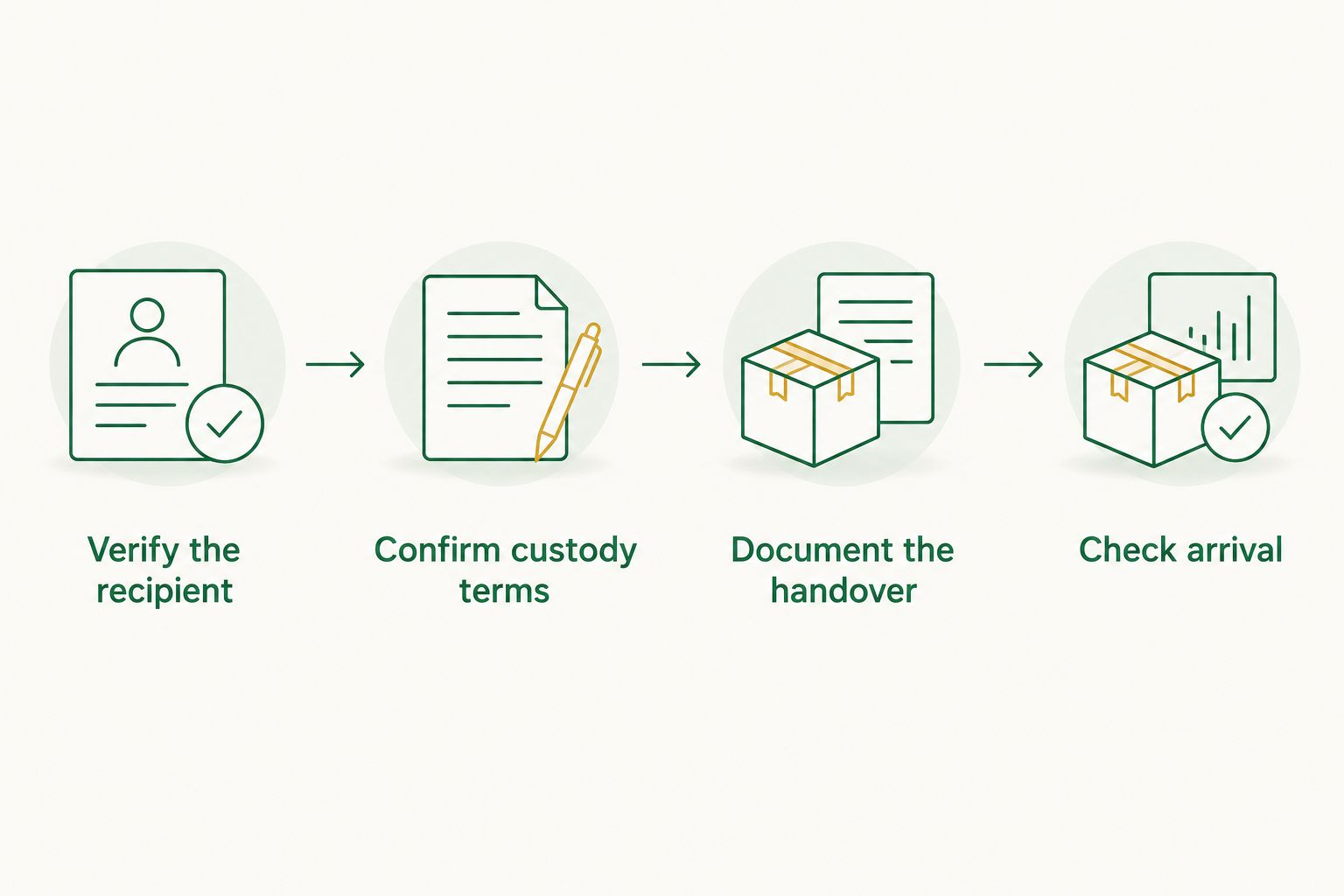
- Verify the recipient independently. Confirm the business identity and agreed destination using a communication channel you have already verified. Treat an unexpected address change as a reason to stop and reconfirm.
- Agree on inspection authority. Ask who examines the watch and whether any opening, testing, disassembly, or outside assessment requires your permission. Do not assume an evaluation authorizes repairs or polishing.
- Confirm custody terms. Establish who is responsible while the watch is in transit and during inspection. Ask how the watch returns to you if no agreement is reached, including responsibility for associated charges.
- Document the handover. For an in-person transfer, obtain a receipt identifying the watch and included items. For shipping, photograph the contents and packing, retain the dispatch receipt, and follow the confirmed coverage requirements.
- Check arrival. Obtain acknowledgment that the recipient received the watch and accessories. A carrier delivery scan and a buyer’s inventory acknowledgment answer different questions; keep both.
Expected result: The watch has a documented custodian, the inspection has agreed boundaries, and you know the exit procedure before accepting a final offer.
Keep full serial numbers out of public listings and social posts. Share identifying details privately when necessary for a verified evaluation, and retain a copy of precisely what you disclosed.
Final acceptance and payout verification
- Review the inspected offer. Match the final description to your Cartier Tank and included accessories. Ask the buyer to explain any change from the preliminary assessment in writing.
- Check the complete agreement. Confirm the amount payable to you, every deduction, the payment recipient, the payment method, and the event that triggers settlement. Read any ownership-transfer or release language before signing.
- Verify payment instructions. Provide sensitive details through the agreed secure channel. Reconfirm unexpected changes through a known contact method rather than replying only to the message announcing the change.
- Verify receipt yourself. Check your own financial account and ask your financial institution about payment status and applicable reversal risks. A screenshot, payment email, or buyer’s assertion is not independent confirmation.
- Close the record. Save the signed agreement, handover receipt, final assessment, payment confirmation, and correspondence together. Mark the transaction settled only when its contractual obligations are satisfied.
Expected result: Your 2026 payout record connects the identified watch, accepted terms, and verified payment without relying on a verbal promise.
Do not substitute a promised turnaround for a defined payment trigger. Ask whether settlement follows inspection, acceptance, receipt of signed documents, or another stated event, and get the answer in writing.
Second workflow: trade your Cartier Tank toward another watch
A trade makes sense when replacing the watch is already your goal. Request the Cartier Tank trade allowance separately from the replacement-watch proposal. That separation lets you judge the disposal and purchase decisions independently.
- Submit the same identification and condition file used for an outright-sale inquiry.
- Request both the outright-sale assessment and the trade proposal, if the retailer offers both for your watch.
- Obtain the replacement watch’s exact reference, condition, included accessories, and transaction terms in writing.
- Confirm what happens if either watch fails inspection or either party declines the revised agreement.
- Agree on custody, delivery, and settlement for both watches before transferring your Cartier Tank.
Expected result: You understand what you are giving up and what you are receiving. Keep the two watch descriptions in separate sections of your 2026 trade record, even if the agreement combines them.
A trade’s advantage is a connected transaction. Its drawback is that enthusiasm for the replacement can distract you from the terms on your existing watch. Finish the comparison before committing to either side.
Troubleshooting
The final offer is lower than the estimate
Ask for the inspection findings and the specific reasons for the revision. Compare them with your original disclosures, then accept or decline under the agreed terms. Do not treat delivery of the watch as automatic acceptance of a revised offer.
You cannot find the original papers
Disclose the missing documents at the start. Send the records you do have and ask whether the buyer will evaluate the watch without the original papers. Do not describe a box and unrelated booklet as a matching documentation set.
The watch is not running
Describe it as not running rather than assuming it only needs a battery. Ask whether the buyer accepts an as-is evaluation before authorizing work; a non-running watch requires assessment, not a seller’s remote diagnosis.
The buyer sends only a payment screenshot
Verify the transaction through your own account and financial institution. Keep the handover and ownership-transfer conditions aligned with your written agreement, and do not let an image of a payment replace independent verification.
Customize your workflow
Use a reusable sale-file template if you manage a collection. Keep identity, condition, accessories, offers, custody, and settlement in separate sections so you can update one without losing the original record.
For another luxury-watch inquiry with Luxurytimenyc, reuse the structure—not the previous watch’s description. Each reference needs its own photographs and disclosures. If your objective changes from selling to trading, request a new written proposal rather than assuming earlier terms still apply.
FAQ
What is the best way to sell my Cartier Tank watch?
Start by identifying the exact reference and preparing a consistent condition file, then request written offers with inspection and payout terms. Choose outright sale, consignment, or trade according to the transaction you want, not the headline offer alone.
Can I sell a Cartier Tank without its box and papers?
Ask the prospective buyer whether it will evaluate your Cartier Tank without the original box and papers. Disclose the missing items before requesting an assessment and provide any ownership or service records you hold.
Will Luxurytimenyc buy my Cartier Tank?
Confirm acceptance of your exact Cartier Tank directly with Luxurytimenyc. The retailer buys and trades luxury watches, but acceptance and transaction terms must be established for your specific watch.
How long does a Cartier Tank payout take?
The payment timeline must be confirmed in the buyer’s written agreement. Ask what triggers payment, what documents are required, and how inspection or a revised offer affects settlement.
Should I service my Cartier Tank before selling it?
Request an as-is assessment before authorizing service solely for a sale. Disclose running condition and known faults, then decide whether any proposed work serves your transaction.
Is trading a Cartier Tank better than selling it?
Trading fits owners who already intend to buy another watch; selling fits owners seeking a separate disposal transaction. Compare the standalone sale assessment with the trade allowance and replacement-watch terms.
How do I know the buyer has paid me?
Verify payment through your own financial account and financial institution. A buyer’s screenshot or confirmation message does not establish the payment’s status or applicable reversal risks.
One last thing
Document the clasp as carefully as the dial. A sale concerns the whole watch and the accessories you promise to deliver, not just its most recognizable face. Before handover, compare the physical contents with your inventory and correct any mismatch in writing.