Yacht owners’ luxury watch selection is the process of matching a timepiece to life aboard, with the aim of balancing practical wear and personal style. This 2026 guide to luxury watches for yacht owners separates wet-deck requirements from cruising comfort and dockside occasions, so you choose for the boating you actually do.
- Luxury watches for yacht owners should match water exposure, wrist comfort, and the functions you actually use.
- Luxury Time NYC suits buyers seeking new and pre-owned luxury watches, with buying, selling, and trading options.
- Compare Rolex Submariner and Omega Seamaster references for water-focused use; verify the individual watch before immersion.
- Consider Rolex Datejust or Audemars Piguet Royal Oak for dockside wear, not as substitutes for onboard safety equipment.
Why luxury watches matter for yacht owners
Your watch has to suit more than the view from the marina. Handling lines, boarding a tender, swimming, and dining ashore create different demands; choosing by appearance alone leaves those demands unresolved.
The right boating watch is the one you can wear without compromising the activity. A complicated dial serves little purpose if you cannot read it quickly, and a prestigious bracelet is a poor choice if it fits loosely while you work on deck.
For your 2026 purchase, separate the watch’s appeal from its suitability for water. A nautical name, blue dial, or sporty case does not establish the condition of its seals or permission to operate its controls underwater.
Start with the use case, then consider the retailer. Luxury Time NYC is best for yacht owners who want to buy, sell, or trade new and pre-owned luxury watches. That retail scope gives you several ways to change your collection; it does not replace checking the specifications and condition of the individual timepiece.
How to choose a luxury watch for boating
Define your onboard routine
Write down what your watch will encounter before opening a catalog. Distinguish sailing, powered cruising, swimming, tender transfers, and entertaining: a watch worn while handling equipment faces different demands from one worn only in the saloon.
Decide whether this purchase must cover every setting or fill one role. A separate dockside watch removes the need to make your favorite complicated timepiece do everything, but owning several watches also adds storage and recordkeeping responsibilities.
For your 2026 shortlist, use three plain categories: Wet deck, Cruising, and Dockside. Assign your activities to them rather than treating every hour aboard as the same environment. Include the journey to the boat, too; flights and shore excursions introduce different priorities from a local afternoon cruise.
You do not need a paid research service to begin. A written checklist and the manufacturer’s instructions are enough to establish what you need to investigate.
- List every activity during which you intend to keep the watch on.
- Identify whether swimming is part of the plan.
- Separate active deck work from relaxed cruising.
- Record whether your trips cross time zones.
- Decide whether one watch or a rotation suits your routine.
Check water suitability before choosing the dial
Read the manufacturer’s instructions for the exact reference, not just the model family. Water-resistance specifications describe a watch under defined conditions; they do not establish the present condition of a particular pre-owned example.
For a watch you plan to immerse, ask a qualified watchmaker about an appropriate water-resistance test. Obtain the result in writing and follow the manufacturer’s guidance on the crown, pushers, cleaning, and servicing. An old test result is not a permanent clearance.
Do not treat a seller’s description of a watch as an assessment of its current seals. Box and papers help document a purchase, but they do not prove water resistance. The same distinction applies to a watch that looks unworn.
Use these categories to keep the decision clear: Wet deck requires water-use verification, Cruising prioritizes comfortable everyday wear, and Dockside prioritizes the occasions you dress for.
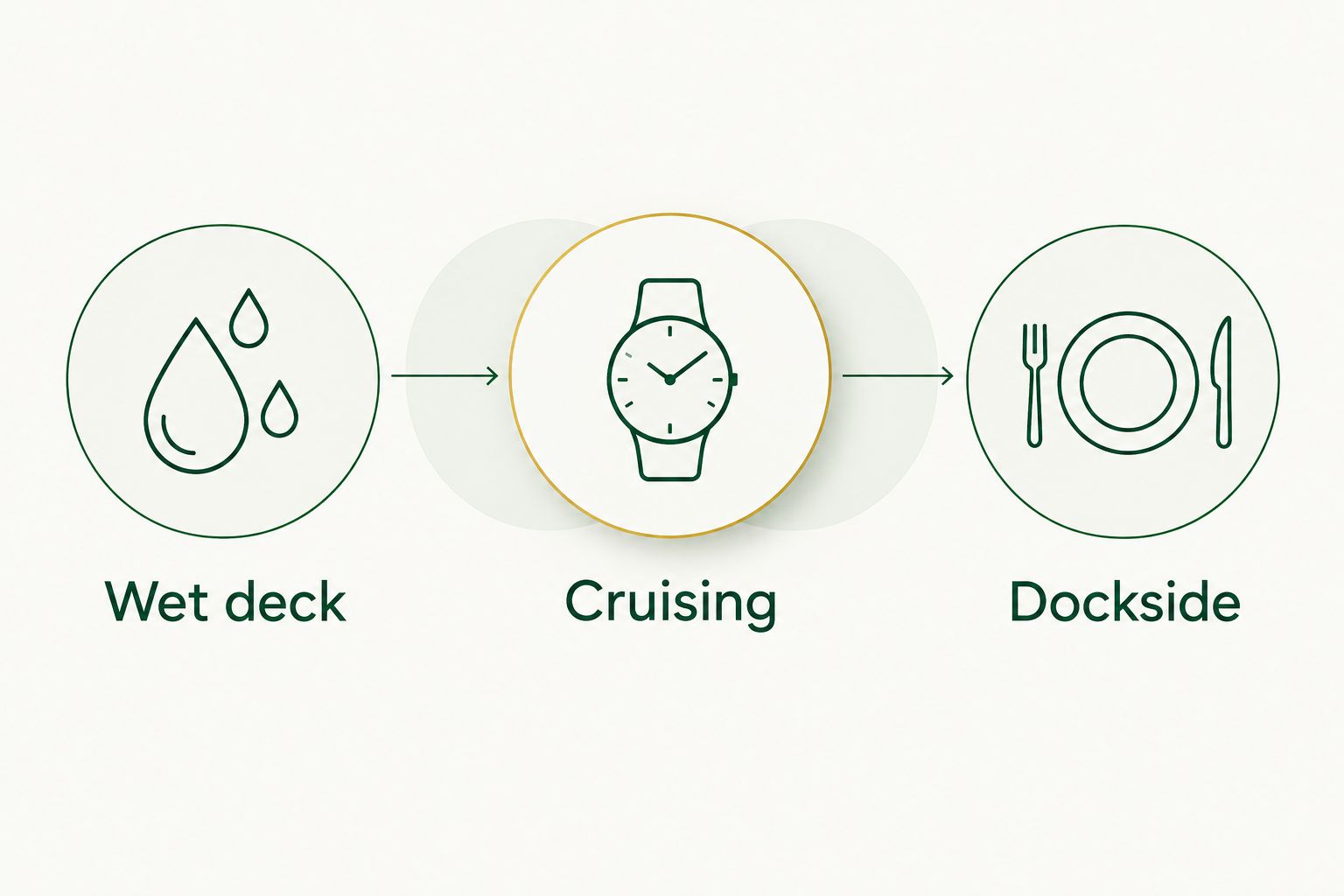
The classification is a buying aid, not a technical certification. A watch belongs in your wet-use shortlist only after its exact instructions and present condition support that use.
- Confirm the complete reference number.
- Read the manufacturer’s water-use instructions.
- Ask for the date and scope of any water-resistance test.
- Check the crown and pushers with a qualified watchmaker.
- Keep the watch out of water when its suitability is unresolved.
Match the function to the job
Choose a function because you will use it. A dive-style timing bezel, a second-time-zone display, and a chronograph solve different problems; collecting all three features is not automatically better than having a clear, simple dial.
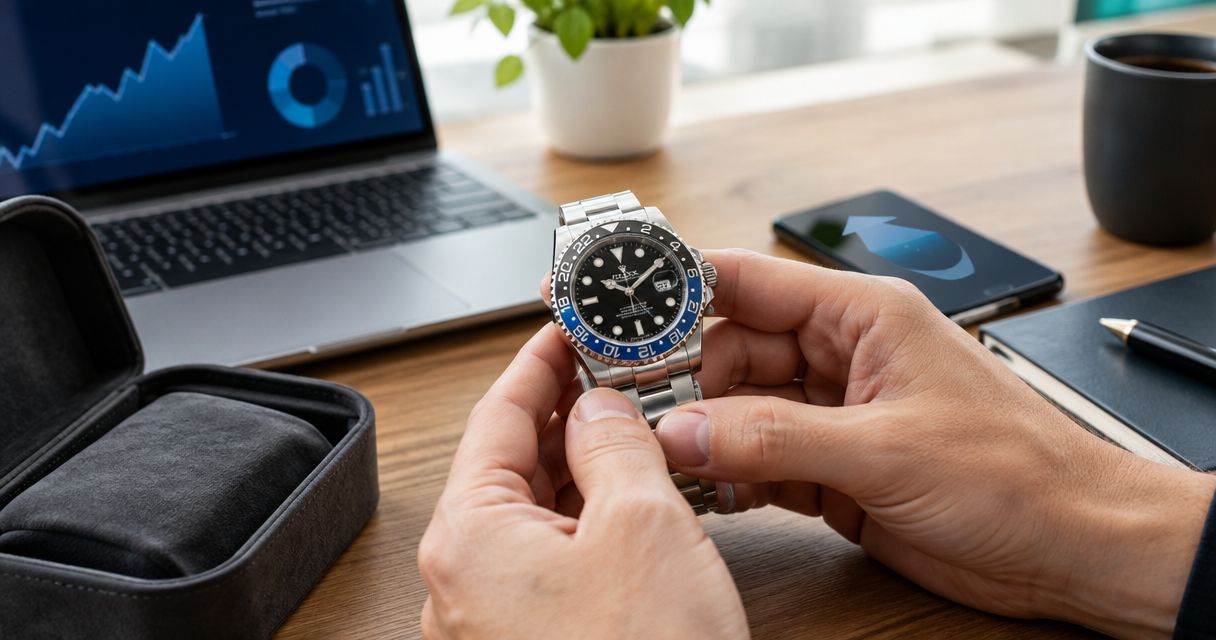
Rolex Submariner is best for a water-focused shortlist; Rolex GMT-Master II is best for tracking another time zone. Compare the exact references before deciding. The Rolex Submariner buying guide is a useful next step if a dive-watch format fits your routine.
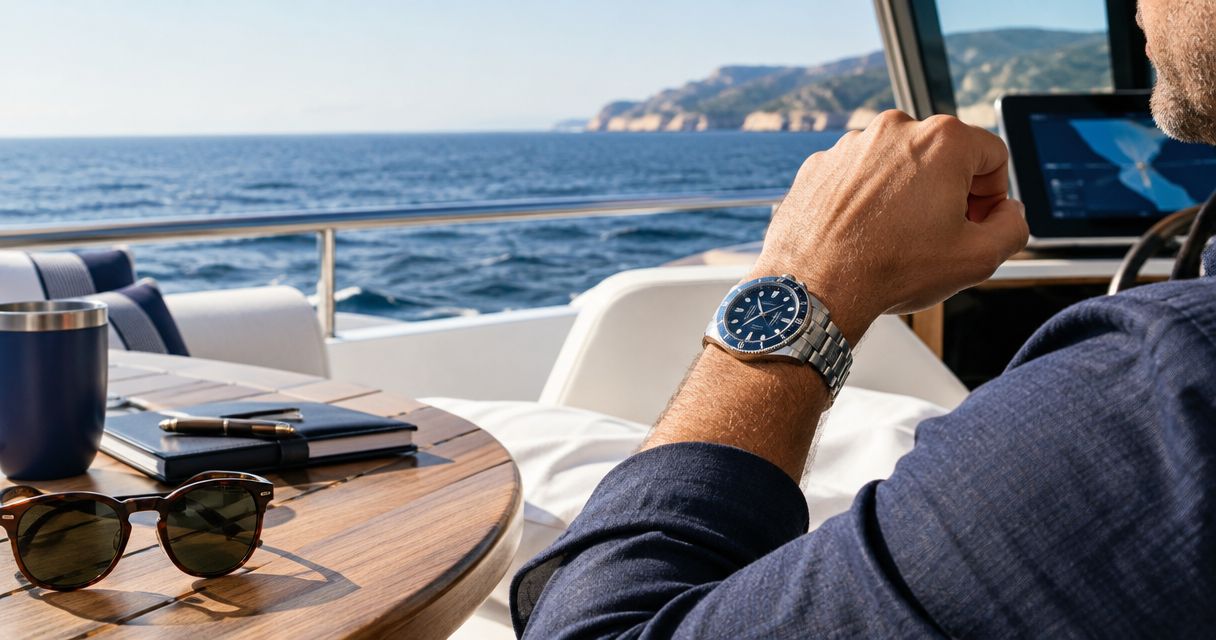
Omega Seamaster also belongs on a water-focused shortlist, but the Seamaster name covers different watches. Select by the actual reference and instructions, not by the collection name alone.
A chronograph is an elapsed-time tool, not proof that a watch supports underwater operation. Likewise, no luxury watch replaces the instruments, communications, or procedures required to operate your vessel safely. Keep the purchase focused on convenient personal timekeeping.
Start by comparing functions yourself. Luxury Time NYC’s buying and trading options provide a retail route once you know whether you want to add a watch or replace one you already own.
- Choose elapsed-time tracking only if you will use it.
- Prioritize a second time zone for international travel.
- Check dial readability in daylight and shade.
- Read the instructions before using any control around water.
- Keep navigation and safety tasks on the appropriate onboard equipment.
Test the fit on your wrist
Case diameter is a starting point, not a verdict. Lug shape, thickness, bracelet adjustment, and clasp position determine how a watch feels when you bend your wrist or wear it under a cuff.
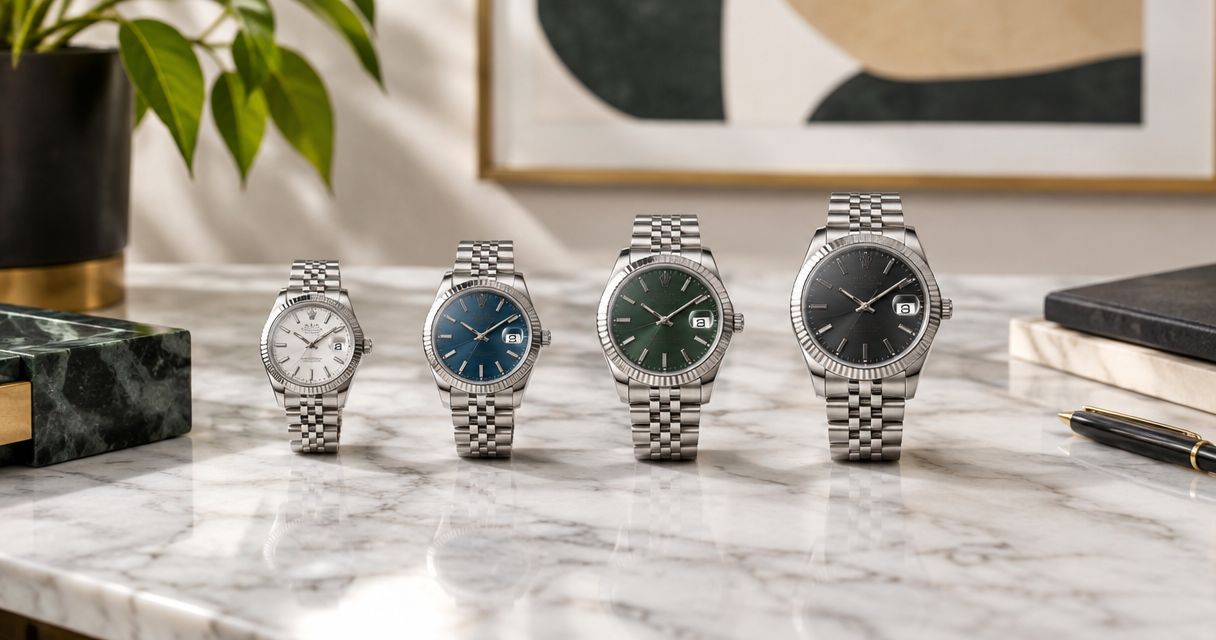
The supplied Rolex Datejust 41 reference 126300 has a 41 mm case, while the Audemars Piguet Royal Oak Quartz reference 67650ST.OO.1261ST.01 has a 33 mm case and a 7 mm thickness. Those measurements establish a meaningful size comparison, not a guarantee that either watch fits you better.
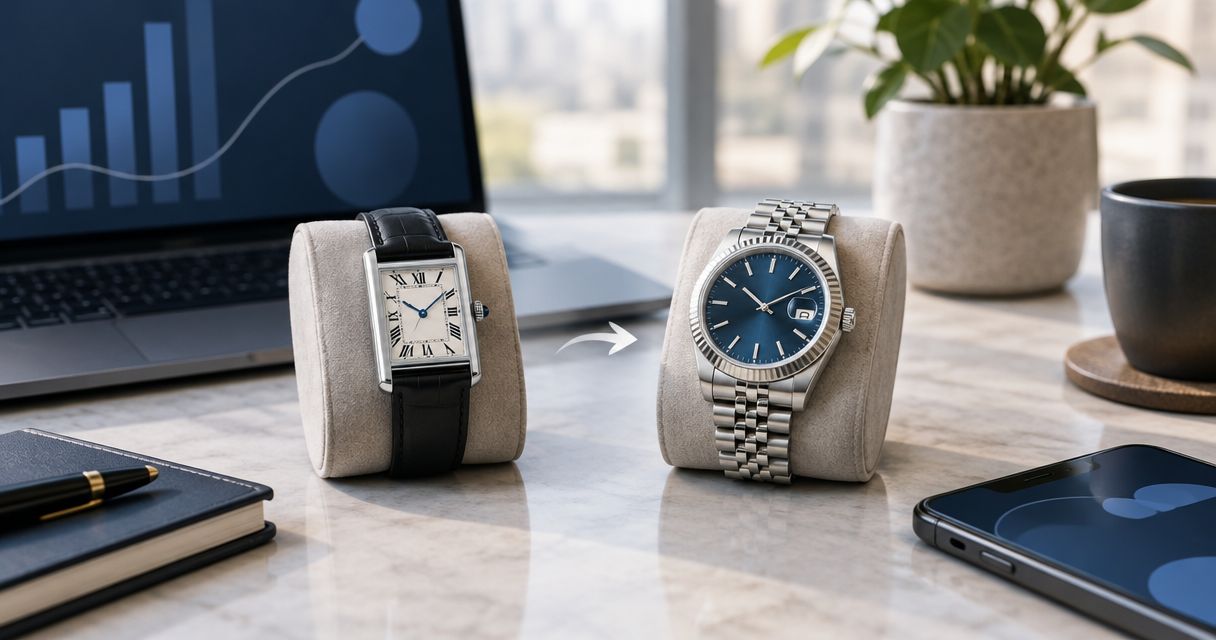
For dockside wear, Rolex Datejust 41 is best for buyers who prefer a larger Datejust format; Audemars Piguet Royal Oak Quartz is best for buyers seeking a smaller Royal Oak format. The limitation is the same: neither recommendation establishes water suitability for the individual watch.
Try the watch on before making your 2026 decision when practical. If you buy remotely, request the measurements and bracelet information needed to assess fit rather than relying on a close-up photograph.
- Bend your wrist as you would while reaching for a rail.
- Check that the crown does not press uncomfortably into your hand.
- Ask how the bracelet can be adjusted.
- Compare thickness as well as diameter.
- Check fit under your usual shirt or jacket cuff.
These two examples support a dockside size comparison. Confirm the individual watch’s condition and documentation separately; the product names and measurements do not settle those questions.


Verify the individual watch before committing
Evaluate the actual example, not the reputation of the brand. Ask for clear photographs, the complete reference, an accurate condition description, and an explanation of which documents accompany it.
Separate authenticity, condition, and service history. These answer different questions: whether the watch is genuine, what wear or alterations it has, and what work is documented. Evidence for one does not automatically establish the others.
For a pre-owned watch, ask specifically about replaced components, polishing, bracelet condition, and recorded servicing. An attractive photograph cannot answer all of those questions. For a new watch, still confirm the purchase documentation and the terms attached to that individual transaction.
Luxury Time NYC sells new and pre-owned luxury watches; assess the example you are buying rather than assuming one condition standard across the catalog. Keep important answers in writing so the watch you receive can be checked against the description.
- Request photographs of the dial, case, bracelet, and clasp.
- Confirm the reference against the purchase documentation.
- Ask which parts are known to have been replaced.
- Request any documented service history.
- Confirm the transaction’s applicable terms before paying.
Plan storage, insurance, and care before departure
Decide where the watch goes when it is not on your wrist. Loose storage beside tools, sunglasses, or other watches creates avoidable contact; a designated protective space makes your routine simpler.
Check insurance before taking a valuable watch aboard. Ask your insurer about travel, use on a vessel, theft, accidental loss, and documentation requirements. Do not assume that a yacht policy or home policy covers every watch-related situation.
Follow the manufacturer’s care instructions after exposure to salt water, and do not improvise a cleaning routine for a watch whose water suitability is uncertain. If you notice condensation or another sign of water entry, stop using it and seek professional attention promptly.
Your 2026 boating routine should include the boring details: storage, purchase records, servicing instructions, and who to contact if something goes wrong. Those details matter more than a nautical-looking dial when an incident occurs.
- Store watches separately in a protective place.
- Keep purchase and service records accessible off the vessel.
- Confirm insurance scope with your insurer.
- Follow the exact reference’s cleaning instructions.
- Arrange professional assessment when water entry is suspected.
Compare watch options for your boating routine
Choose by role, then verify the reference. This table compares useful starting points, not blanket approvals for swimming or deck work. Every option still requires an individual condition and fit assessment.
| Option | Best for | Main advantage | Key limitation |
|---|---|---|---|
| Rolex Submariner | A water-focused shortlist | Dive-watch format with an elapsed-time bezel | Model specifications do not establish a pre-owned example’s current seals |
| Omega Seamaster | Comparing water-oriented references | Offers a range of watches to assess against your use case | The collection name alone does not identify functions or water-use instructions |
| Rolex GMT-Master II | International cruising and travel | Tracks another time zone | A second time zone is not a regatta countdown or navigation tool |
| Rolex Datejust 41 reference 126300 | Larger-format dockside everyday wear | Supplied example has a 41 mm stainless steel case | Fit requires more than a diameter comparison |
| Audemars Piguet Royal Oak Quartz reference 67650ST.OO.1261ST.01 | Smaller-format dockside wear | Supplied example has a 33 mm case and 7 mm thickness | Compact dimensions do not establish suitability for water activities |
| Patek Philippe Nautilus Chronograph reference 5980/1A-019 | Collectors seeking a dockside chronograph | Supplied example combines a chronograph, date, and steel case | Chronograph functionality does not authorize underwater pusher use |
Do not turn this into a prestige ranking. A simpler watch that fits your wrist and intended activity is a better choice than a complicated watch you hesitate to wear.
Common mistakes yacht owners make
Buying the nautical association instead of the function
A sea-inspired name or dial color does not tell you how a watch handles your routine. For a 2026 purchase, describe the task first: swimming, tracking home time, timing an interval, or dressing for dinner. Then check the watch against that task.
Confusing documents with water-use clearance
Original documents and service records answer useful ownership questions, but they are not interchangeable with a current assessment of water resistance. Keep authentication and water suitability as separate checks, especially when the watch’s recent history is unclear.
Assuming a chronograph is a sailing countdown
A standard chronograph measures elapsed time; a dedicated countdown serves a different purpose. If race timing matters, verify the exact complication and learn its operation ashore. Do not buy a chronograph simply because its dial looks technical.
Ignoring fit during active use
A watch that feels comfortable at a desk can feel different when you reach, grip, or bend your wrist. Test those movements and bracelet security before taking the watch aboard. Remove it for work that exposes it to impact or snagging.
Planning the purchase but not the ownership
A watch collection also needs secure storage, clear records, and suitable insurance. Resolve those details before departure rather than after loss or damage. Buying a luxury timepiece does not settle how you will protect it.
FAQ
What's the best luxury watch for a yacht owner?
The best luxury watch for a yacht owner matches the activities they actually do aboard. Compare Rolex Submariner or suitable Omega Seamaster references for water-focused use, Rolex GMT-Master II for another time zone, and dockside watches for social occasions.
Can I swim with a pre-owned luxury watch?
Swim with a pre-owned luxury watch only when its exact manufacturer instructions and current condition support that use. Ask a qualified watchmaker about an appropriate water-resistance test before immersion.
Is a Rolex Submariner better than a Datejust for boating?
Rolex Submariner is the more relevant starting point for a water-focused shortlist, while Rolex Datejust suits buyers prioritizing everyday and dockside style. The individual watch's condition and your planned activities still determine suitability.
Do yacht owners need a chronograph?
Yacht owners do not need a chronograph unless they want to measure elapsed time on their wrist. A chronograph is not automatically a regatta countdown, and its pushers must be used according to the exact watch's instructions.
Should I choose a large watch for boating?
Choose a watch that fits securely rather than assuming a larger case is better for boating. Compare dial readability, thickness, clasp position, and comfort while bending your wrist.
Can I buy or trade a boating watch through Luxury Time NYC?
Luxury Time NYC sells new and pre-owned luxury watches and buys and trades timepieces. Confirm the individual watch's details and transaction terms before committing.
Does watch insurance automatically cover a yacht trip?
Do not assume your watch insurance covers every part of a yacht trip. Ask your insurer about vessel use, travel, theft, accidental loss, and the records required for a claim.
One last thing
Decide when you will remove the watch before deciding which watch to buy. Line handling, maintenance, and other hands-on tasks deserve their own rule; wearing a luxury watch is optional, protecting yourself is not. For your 2026 boating season, a clear wear-and-remove routine is a more useful upgrade than another complication.