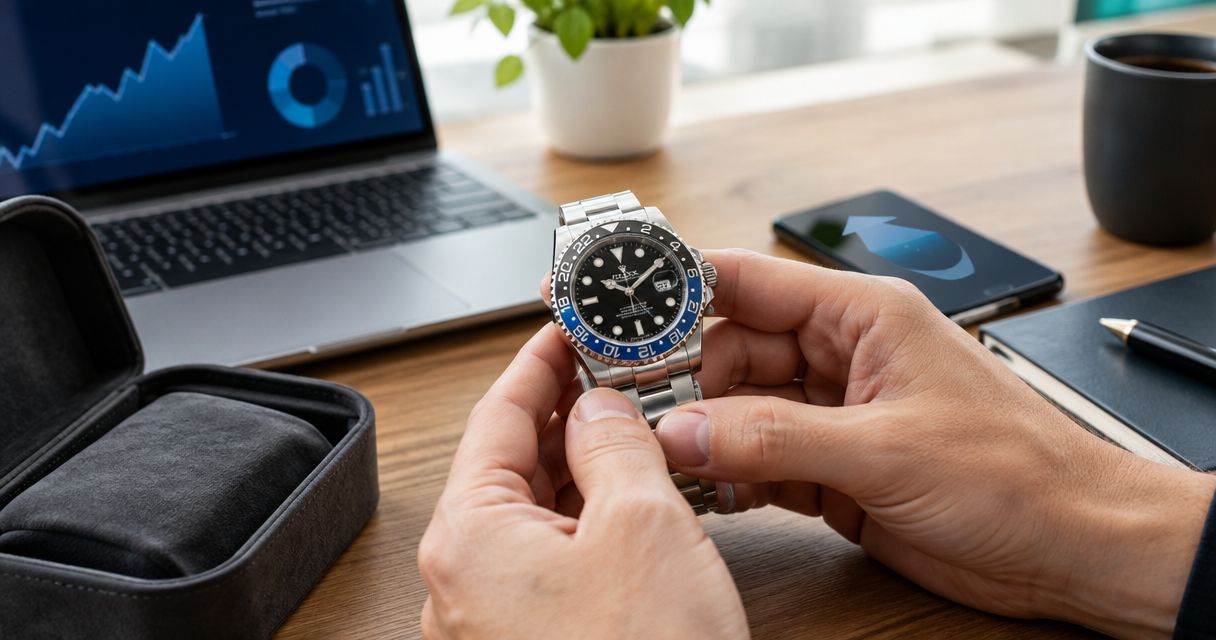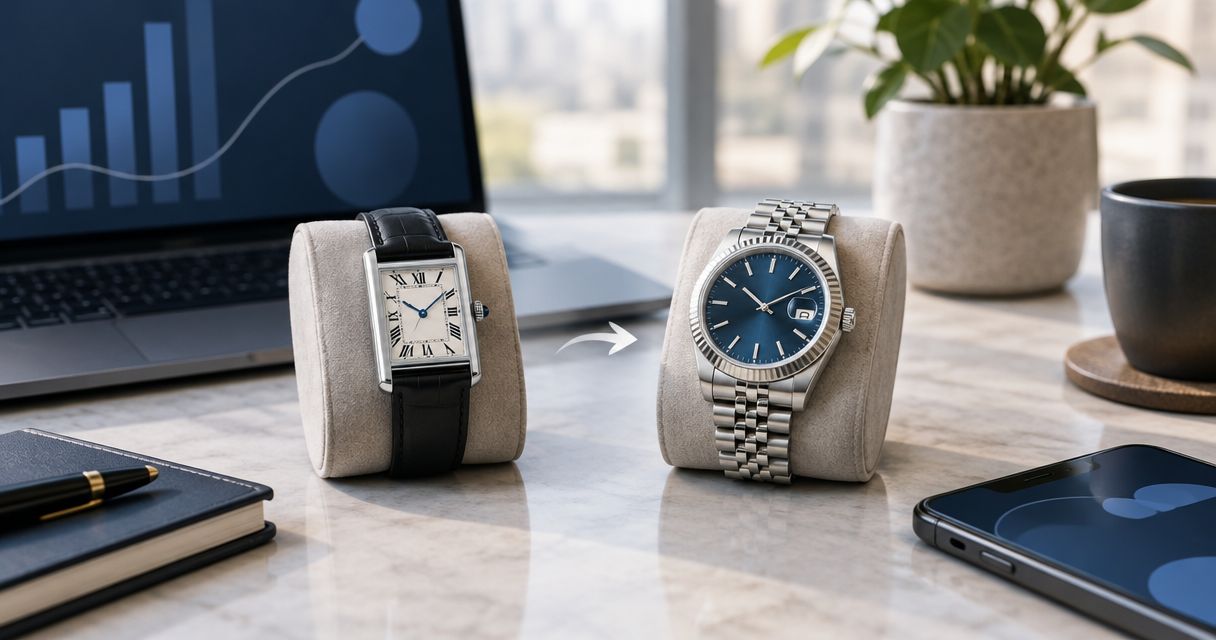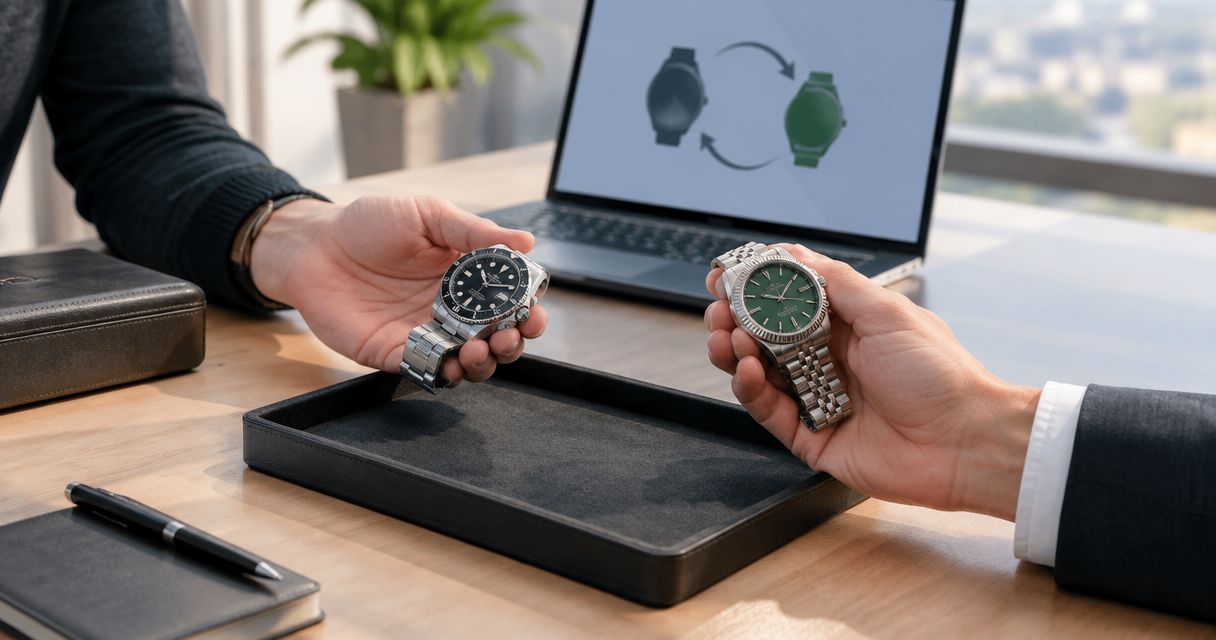
Instead of guessing what your Omega is worth and shopping for a Rolex separately, prepare one accurate watch record, request a trade assessment, and compare the complete exchange before you agree. To trade in Omega for Rolex in 2026, judge the deal by the Omega credit, the exact Rolex reference, and the final balance together. Start with Luxury Time NYC, which buys and trades watches as well as selling new and pre-owned Rolex models.
- To trade in Omega for Rolex in 2026, compare the Omega credit and the exact Rolex you receive as one deal.
- Luxury Time NYC is best for collectors who want to discuss an Omega trade and a Rolex purchase with one retailer.
- Record the Omega reference, condition, service history, and included accessories before requesting an assessment.
- Compare a direct trade with selling your Omega separately; neither route wins without complete terms.
Why this matters
An Omega-to-Rolex upgrade has 2 moving parts: what you give up and what you receive. A strong-looking trade credit does not settle the question if you have not identified the Rolex reference, its condition, and the final amount due. The reverse is true, too: a Rolex you want is not automatically the right exchange for an Omega you value.
Luxury Time NYC is best for watch collectors who want to discuss an Omega trade and a Rolex purchase with the same retailer. The advantage is a single conversation about both watches. The limitation is that you still need enough information to judge the trade against a separate sale and purchase; do not treat a convenient process as proof of a better deal.
This 2026 workflow keeps the decision in order: document your Omega, identify the Rolex, request written terms, and approve the exchange only after both sides are clear. You do not need to commit your watch just to begin comparing options.
Before you start
- Identify your Omega precisely. Record the collection, model or reference number, case material, dial, bracelet or strap, and any features that distinguish it. Use your own watch and documents rather than relying on a similar-looking listing.
- Gather what belongs with the watch. Set aside its box, cards or papers, spare bracelet links, service records, and any original parts you still have. List what is missing as carefully as what is present.
- Choose a Rolex target, not just a brand. Decide which model, reference, case size, dial, and bracelet you would accept. The mid-process trap is getting an Omega assessment before you have defined the Rolex: a trade figure alone cannot tell you whether the upgrade works.
Keep personal records of your watch separate from the information you share initially. Follow the retailer’s instructions for any photographs, inspection, or transfer rather than assuming that an online assessment is a final offer. In 2026, the goal at this stage is a usable comparison, not a rushed commitment.
Build your Omega record
- Read the reference from reliable records. Check the paperwork you possess and the identifying details on your watch. If the records and watch do not agree, flag that discrepancy rather than choosing the number that seems more attractive.
- Photograph the actual condition. Capture the dial, case sides, crystal, clasp, bracelet or strap, case back, and any visible wear. Include clear views of damage; surprises discovered at inspection can change an assessment.
- Inventory the set. Write down each accompanying item and whether it belongs to this watch. A box or card from another watch does not become part of the Omega’s set because it fits the presentation.
- Note service and changes. Record known servicing, replacement parts, polishing, and work that remains uncertain. If you cannot document a claim, mark it as unknown instead of presenting it as fact.
Expected result: You have one description that another person can check against the physical Omega. That record makes later differences between an initial assessment and inspected terms easier to identify.
A watch can be appealing on the wrist and still require a careful trade description. Normal wear, a changed component, or incomplete accessories are not reasons to abandon the process; they are reasons to make the starting information accurate. Do not clean up the story to improve an estimate. You need terms that can survive inspection.
Define the Rolex upgrade
- Name the model and reference. A request for a Rolex Datejust is a starting point, not a complete target. Specify the case size, dial, bezel, and bracelet that matter to you, then distinguish requirements from preferences.
- Decide between new and pre-owned. Luxury Time NYC sells both. Ask about the condition and included items of the particular watch under discussion rather than assuming every example of a model has the same history or set.
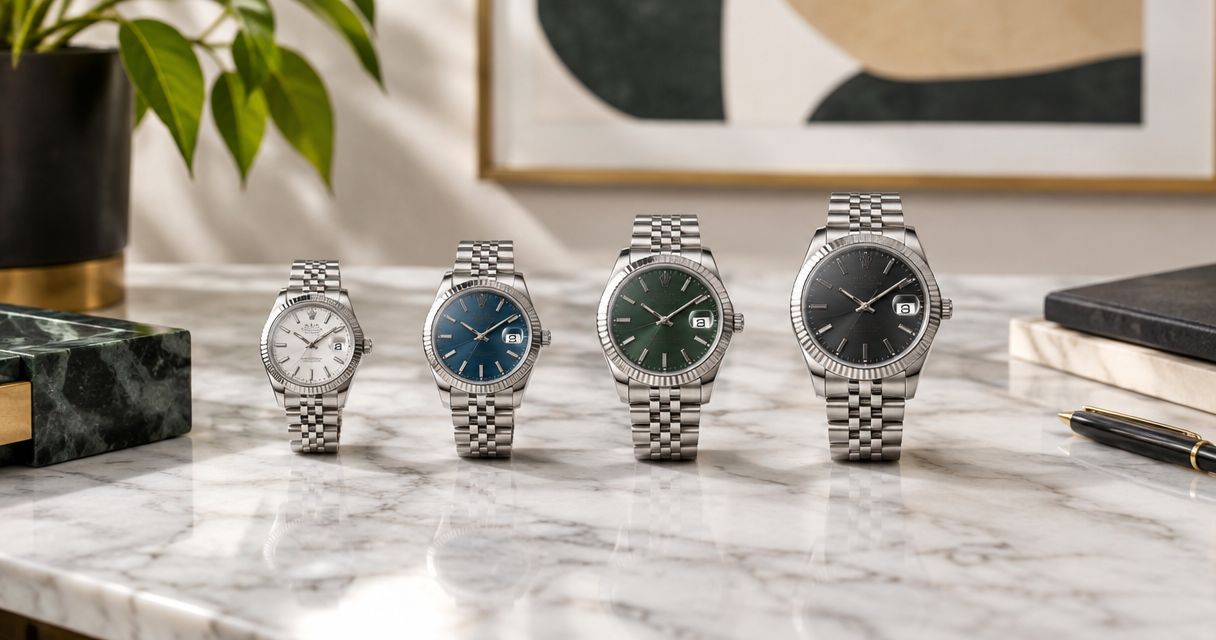
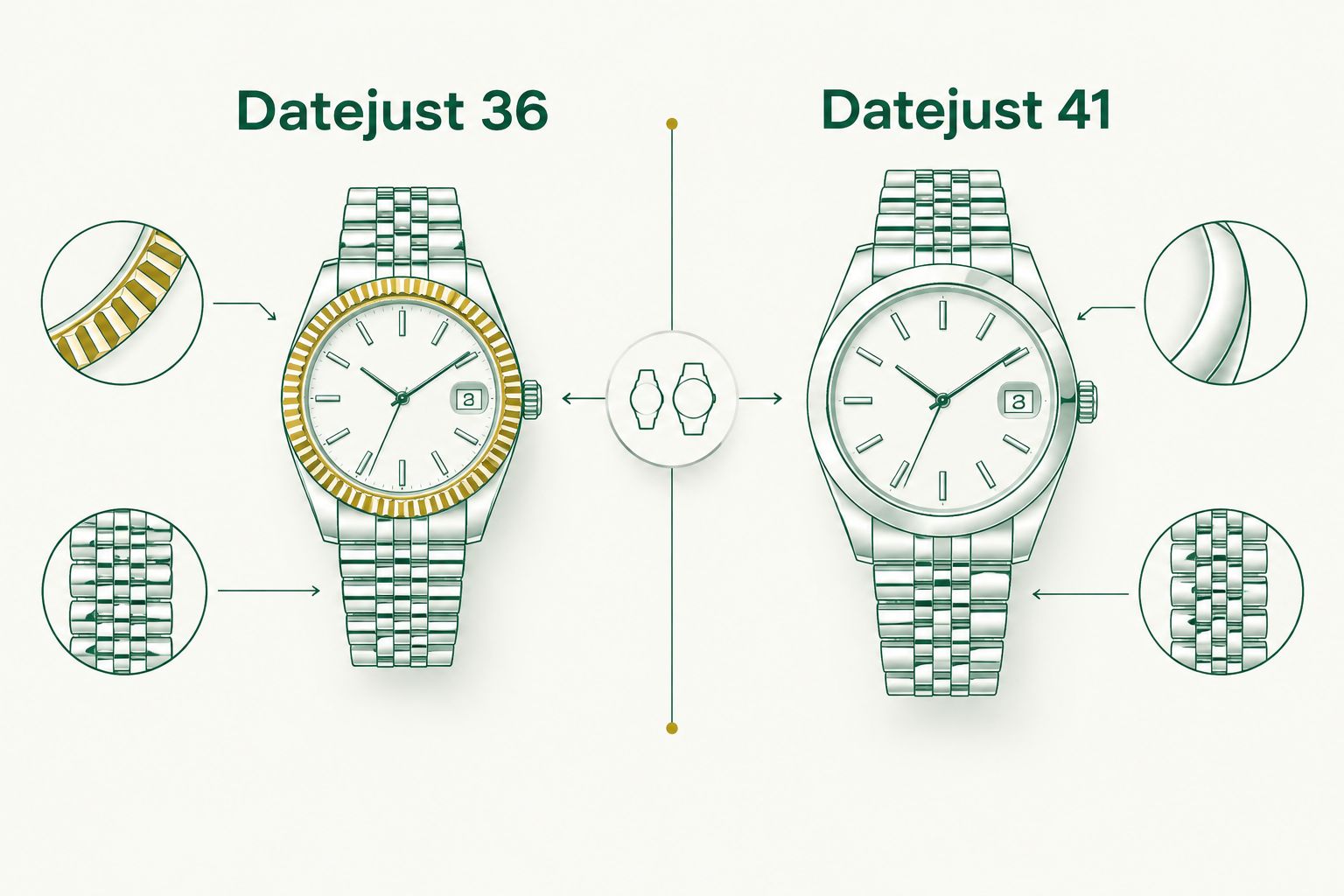
- Check the actual configuration. The supplied product descriptions include a Datejust 41 with a 41 mm steel case, mint-green dial, smooth bezel, and Jubilee bracelet, plus a Datejust 36 with a mint-green dial, fluted bezel, and Jubilee bracelet. Those are different watches, not interchangeable versions of a generic Rolex upgrade.
- Write down your walk-away criteria. If case size, bracelet, condition, or documentation is essential to you, put it in the request before you discuss the Omega credit. Otherwise, the conversation can drift toward an attractive-sounding exchange for the wrong Rolex.
Expected result: You can identify the Rolex you want without relying on a photograph or a broad model name. You also know which substitutions you would accept and which you would decline.
The case-size decision is especially easy to postpone and hard to ignore once you are wearing the watch. A Datejust 36 and a Datejust 41 differ by 5 mm in their stated case diameters, but diameter alone does not settle your preference. Try on the configurations you are considering when possible, and treat the fit of the actual watch as more useful than a label such as bigger or smaller.
Compare the Datejust configurations
| Rolex option | Stated configuration | Best for | Trade-off to consider |
|---|---|---|---|
| Datejust 41, reference 126300 | 41 mm steel case, mint-green dial, smooth bezel, Jubilee bracelet | A collector seeking this larger case and smooth-bezel combination | It does not satisfy a preference for a 36 mm case or fluted bezel. |
| Datejust 36, reference 126234 | Mint-green dial, fluted bezel, Jubilee bracelet | A collector seeking the smaller case and fluted-bezel combination | It does not satisfy a preference for the 41 mm smooth-bezel version. |
These are examples for defining a target, not a claim that either watch is available for your trade. The better Rolex is the one whose exact configuration you want to own after the Omega leaves your collection. Do not use the model name alone as your acceptance test.


Request and compare trade terms
- Send the Omega record and Rolex target together. Tell Luxury Time NYC which Omega you own, what accompanies it, what you know about its condition, and which Rolex configuration you seek. Ask how an initial assessment is confirmed after inspection.
- Ask for the complete exchange in writing. Separate the credit assigned to your Omega from the terms for the specific Rolex and the final balance. Confirm which Rolex reference and accompanying items those terms cover.
- Clarify the handoff before sending anything. Ask what happens if inspection changes the Omega assessment, when you can accept or decline revised terms, and how the watches move between parties. Use the instructions provided for your transaction; do not assume a shipping, insurance, or return policy that has not been confirmed.
- Compare like with like. Put the direct-trade proposal next to a separate Omega sale and Rolex purchase for the same Rolex configuration. Compare the amount you would need to contribute and the conditions attached to each route, not just the headline Omega figure.
Expected result: You have a proposal that identifies your Omega, the specific Rolex, and the terms of the exchange. If any part is still undefined, the proposal is not ready for approval.
| Route | Best for | Advantage | Limitation |
|---|---|---|---|
| Direct Omega-to-Rolex trade | A buyer who wants to discuss both watches in one transaction | Keeps the watch assessment and Rolex selection in the same conversation | The trade credit must be assessed alongside the Rolex terms. |
| Sell the Omega, then buy a Rolex | A buyer who wants to compare separate proposals | Lets you assess the Omega sale independently of the Rolex purchase | It requires coordinating 2 decisions instead of one. |
| Keep the Omega and defer the Rolex | A collector who is not ready to part with the Omega | Preserves a watch you already know you enjoy | It does not complete the upgrade now. |
No route wins by default in 2026. A direct trade is a good fit when you want that specific Rolex and accept the complete exchange terms. Selling separately is a better test when you want to know whether a different Omega offer changes the decision. Keeping the Omega is a valid choice when neither proposal compensates you for giving it up.
Trade a different Omega for the same Rolex
The workflow also works when you own more than one Omega and are choosing which one to trade. Assess each Omega separately; do not treat the watches as interchangeable contributions toward the Rolex. Their references, condition, accessories, and your attachment to them differ.
Create a separate record for each candidate, then request terms against the same Rolex target. This holds the receiving side of the exchange steady. Compare what you must give up as well as the final balance: the Omega you wear most can be the harder loss even if another watch produces different terms.
Do not submit an unclear combined description and ask the retailer to choose for you. State which watch belongs to each photograph and document. The expected result is 2 distinct proposals you can compare without confusing one Omega’s condition or accessories with the other’s.
Troubleshooting an Omega-to-Rolex trade
- The initial Omega figure changes after inspection. Compare the inspection findings with your original photographs and inventory. Ask which condition detail or missing item changed the assessment, then decide against the revised terms rather than the earlier figure.
- The Rolex in the proposal is not your target configuration. Restate the reference, case size, dial, bezel, and bracelet you require. Do not approve an exchange on the assumption that a similar Datejust will feel the same on your wrist.
- Your Omega paperwork does not match your notes. Pause the assessment and identify the discrepancy. Share what you can verify and mark the rest as unknown; an uncertain reference is not a detail to conceal.
- The proposal names a credit but not a final balance. Request the complete transaction terms for the identified Rolex. A credit in isolation cannot tell you whether the upgrade is acceptable.
- You are unsure what happens if you decline after inspection. Get the process for revised terms and the watch’s return confirmed before the handoff. Do not rely on a policy you have not received for your transaction.
A stalled trade in 2026 usually needs a clearer fact or a clearer term, not a faster decision. Resolve the specific gap first. If the revised Rolex is different, compare it as a new proposal instead of treating it as the original upgrade.
Customize your upgrade decision
If your Omega is a Speedmaster or Seamaster, make its exact reference and condition the center of the outgoing-watch record. A collection name alone does not identify the watch you are trading. If you are still attached to it, compare the trade with keeping the Omega and pursuing the Rolex separately; ownership satisfaction is part of the decision even though it has no entry on a trade worksheet.
If the Rolex target changes, restart the receiving side of the comparison. A Datejust, Submariner, and GMT-Master II are different choices; a proposal for one does not answer whether another is right for you. For a broader Rolex buying checklist, see places to buy a certified pre-owned Rolex.
Keep a copy of your 2026 Omega record, Rolex requirements, and written proposal together. Approve the trade only when the watch you give up, the watch you receive, and the final terms all match what you agreed to. That rule applies whether you settle on a Datejust or change direction entirely.
FAQ
Can I trade in an Omega for a Rolex in 2026?
Yes. Luxury Time NYC buys and trades timepieces and sells Rolex watches. Identify your Omega and the Rolex you want, then request terms for the complete exchange.
What do I need before requesting an Omega trade assessment?
You need an accurate Omega model or reference, condition description, photographs, and a list of included accessories and records. Mark any service or identification detail you cannot verify as unknown.
Is it better to trade an Omega or sell it before buying a Rolex?
Neither route is automatically better. Compare a direct trade with a separate Omega sale and purchase of the same Rolex configuration, using the complete terms for each route.
Will missing Omega papers stop a Rolex trade?
Missing papers do not prevent you from requesting an assessment. Disclose what is missing so the proposed terms reflect the set you actually have.
Should I choose a Datejust 36 or Datejust 41 for an Omega upgrade?
Choose the configuration you want to wear, not a case-size label alone. The examples in this guide differ in case size and bezel, so specify the exact reference and bracelet before requesting trade terms.
Is an initial Omega trade assessment final?
Treat an initial assessment as unconfirmed until you know how inspection affects it. Ask what happens if the assessed terms change and how you can accept or decline the revision.
What should a written Omega-to-Rolex proposal identify?
It should identify the Omega being traded, the specific Rolex being acquired, and the complete exchange terms. Confirm the Rolex configuration and accompanying items before approving the trade.
One last thing
The most useful question is not whether your Omega gets an impressive trade credit. It is whether you would still choose that exact Rolex under the complete terms after seeing both watches described accurately. If the answer is no, keep the Omega while you refine the target; the 2026 workflow is doing its job by preventing the wrong exchange.