Instead of judging a Rolex Daytona from polished listing photos, build a reference-specific evidence file and have a qualified watchmaker inspect the actual watch before you commit. Learning how to authenticate a Rolex Daytona before you buy means matching its identity, checking its components, testing its functions, and documenting the seller's promises—not finding one supposedly foolproof detail.
- How to authenticate a Rolex Daytona before you buy: match the reference, verify documents, and require a physical inspection.
- Rolex Daytona authentication needs movement and component checks; photographs and a matching serial number are not enough.
- Luxury Time NYC serves luxury watch collectors buying, selling, or trading; request watch-specific evidence before committing.
- Separate authenticity, originality, and condition: a genuine Rolex Daytona can contain replacement or aftermarket components.
Why this matters
A convincing exterior is not an authentication result. A genuine case does not establish that the movement, dial, bezel, and bracelet belong together. Equally, a replacement component does not automatically make the entire watch counterfeit.
For a 2026 purchase, separate three questions: Is the watch genuine? Are its components correct for the stated reference? Does its condition match the description? Each needs evidence.
Luxury Time NYC is best for collectors who want to buy, sell, or trade luxury watches through a retailer. When considering a Rolex Daytona from Luxury Time NYC, ask for the same watch-specific documentation you would request from any seller. A retailer's name does not replace inspection.
Before you start
- Get the exact identity: Request the full reference number, seller's stated production period, serial information through a private channel, and a written description of replaced or modified components.
- Arrange access: Obtain clear photographs, permission for functional checks, and an appointment with a qualified watchmaker experienced with Rolex chronographs. Confirm inspection scope before sending payment.
- Avoid the generation trap: Daytona details vary by reference and production period. A caseback, dial layout, or engraving that suits one generation is not a universal authenticity rule. Establish the reference before applying a checklist.
Create a folder for the listing, correspondence, photographs, documents, and inspection report. Keep serial numbers private rather than posting them publicly for opinions.
Watch identity and evidence file
Establish the reference
- Record the reference number. Ask the seller to distinguish the model reference from the unique serial number. They serve different purposes.
- Define the claimed configuration. Write down the case metal, dial, bezel, bracelet, and any gem setting. Ask whether each is factory-original, a Rolex service replacement, or aftermarket.
- Compare like with like. Use Rolex's model information for current references and reliable reference-specific documentation for discontinued watches. Do not compare a vintage Daytona against a current model and expect every feature to match.
- List unresolved discrepancies. Record anything the seller cannot explain, rather than deciding that an unusual detail must be genuine or fake.
For example, the supplied listing for reference 126506 describes a platinum Cosmograph Daytona with a chestnut brown Cerachrom bezel, an ice blue baguette diamond dial, and an Oyster bracelet. Those details establish the configuration to investigate; the listing alone does not authenticate the physical watch.
Expected result: You can describe exactly which Daytona is being offered and identify which claims still require proof. If the seller cannot establish the reference, stop before comparing cosmetic details.
Request an evidence set
- Request 8 photographs: straight-on dial, angled dial, bezel, crown-side case, opposite case side, caseback, bracelet, and open clasp. These are collection instructions, not an authentication threshold.
- Request 1 continuous video. Ask the seller to show the same watch from several angles and demonstrate its chronograph without cuts. Have an experienced person operate it according to the correct instructions.
- Request document photographs privately. Include the warranty card or papers, relevant service records, and any prior inspection report. Ask which documents actually accompany the watch.
- Save the original files. Keep uncropped images where possible and retain the listing description alongside them.
A video supports identification and function screening. It cannot establish the origin of hidden components or prove that the watch shown will be the watch delivered.
Expected result: Your watchmaker receives an organized file instead of screenshots scattered across messages. Every image should relate to the same offered watch.
Exterior and document checks
Review the visible components
- Inspect the dial against the correct reference. Compare wording, printing, markers, hand shapes, subdial arrangement, and the stated dial variant. Look for inconsistencies, not just attractive finishing.
- Compare the case and bezel. Ask the specialist to assess proportions, engravings, material claims, and evidence of alteration. Wear and polishing belong in the condition assessment; neither is a stand-alone counterfeit test.
- Check the bracelet and clasp. Record identifying markings, construction, wear, and whether the seller describes the bracelet as original to the watch or a later replacement.
- Investigate modifications explicitly. Ask about refinished dials, replacement bezels, aftermarket diamonds, and mixed components. Require written answers.
Do not use weight, a smooth-moving hand, or a tiny crown marking as a pass/fail shortcut. Each observation needs reference-specific interpretation. A convincing replica can pass a superficial visual check.
For your 2026 checklist, keep authenticity and originality in separate columns. A watch can contain genuine Rolex components without retaining its original configuration.
Expected result: You have a component-by-component list of consistent details, disclosed changes, and questions for physical inspection—not a verdict based on photographs.
Reconcile the paperwork
- Compare identifiers. Have the specialist reconcile the watch's identifying information with the accompanying documents wherever applicable.
- Read the scope of service records. Look for descriptions of replacement components and work performed. A service document needs to relate to this watch, not merely this model.
- Check the seller's description against the documents. Resolve statements about originality, servicing, and condition that conflict with the paperwork.
- Treat unexplained mismatches as a stop condition. Do not accept a verbal reassurance in place of an explanation that can be checked.
Matching papers support provenance; they do not independently authenticate a Daytona. Genuine documents can accompany the wrong watch, and counterfeit documents can accompany a counterfeit watch. Missing papers also do not prove that a watch is fake.
Expected result: The documents tell a consistent story, or you have clearly identified gaps that need resolution before purchase.
Physical inspection and purchase conditions
Choose the inspection route
For a 2026 Daytona purchase, use remote screening to prepare the inspection—not to replace it. Choose the route that gives a qualified specialist access to the actual watch while keeping the transaction conditions clear.
| Inspection route | Best for | Advantage | Limitation |
|---|---|---|---|
| Remote screening followed by physical inspection | Buyers arranging a purchase at a distance | Organizes evidence before the watch reaches a specialist | Photos and video cannot settle movement authenticity |
| In-person inspection before commitment | Buyers able to attend an appointment | Lets the specialist examine the actual watch before the decision | Requires seller cooperation and agreed inspection access |
Neither route proves authenticity by itself. The specialist's findings, inspection scope, and connection to the delivered watch determine how useful the result is.
Commission the inspection
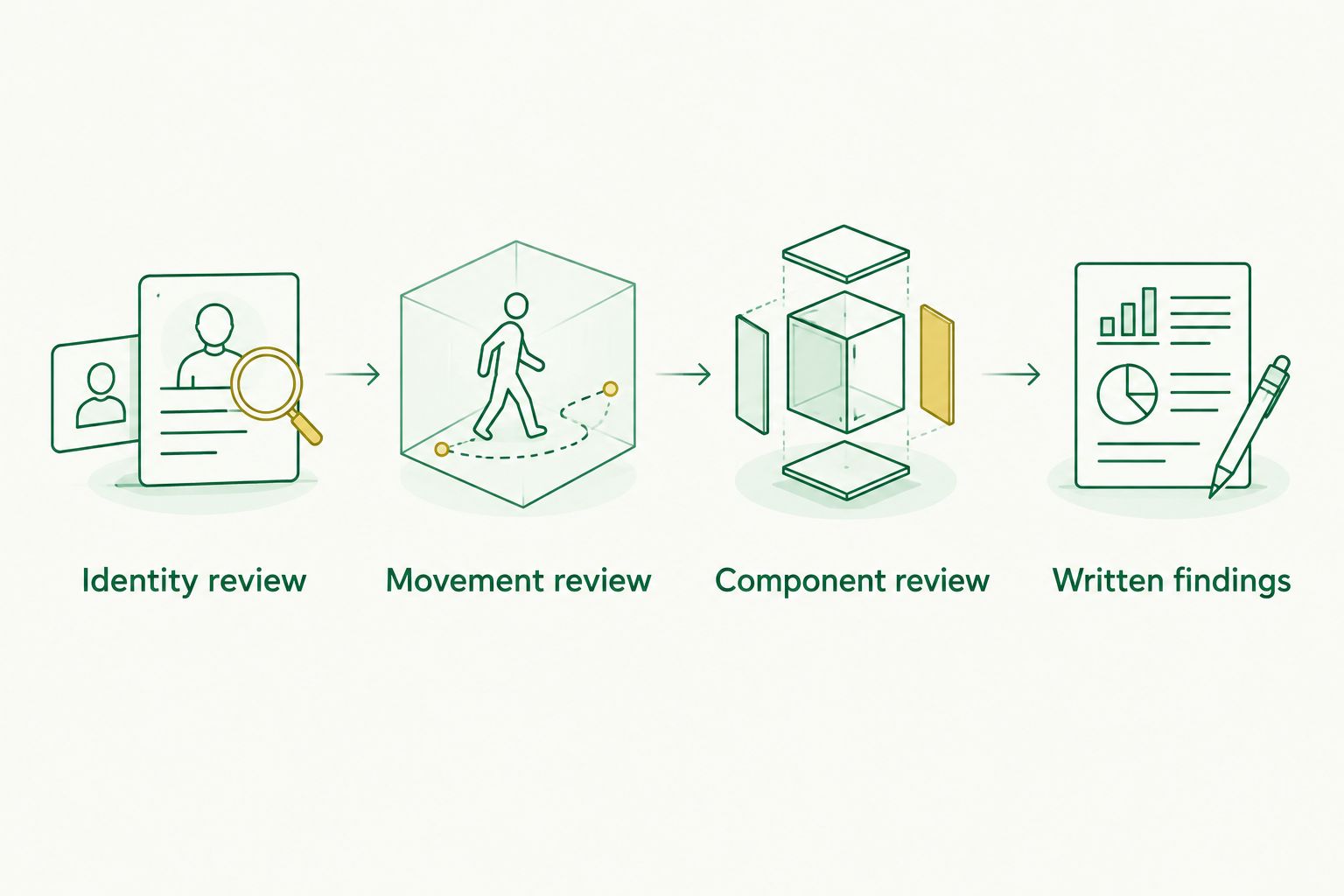
- Specify identity review. Ask the specialist to check that the reference, identifying marks, and claimed configuration are consistent.
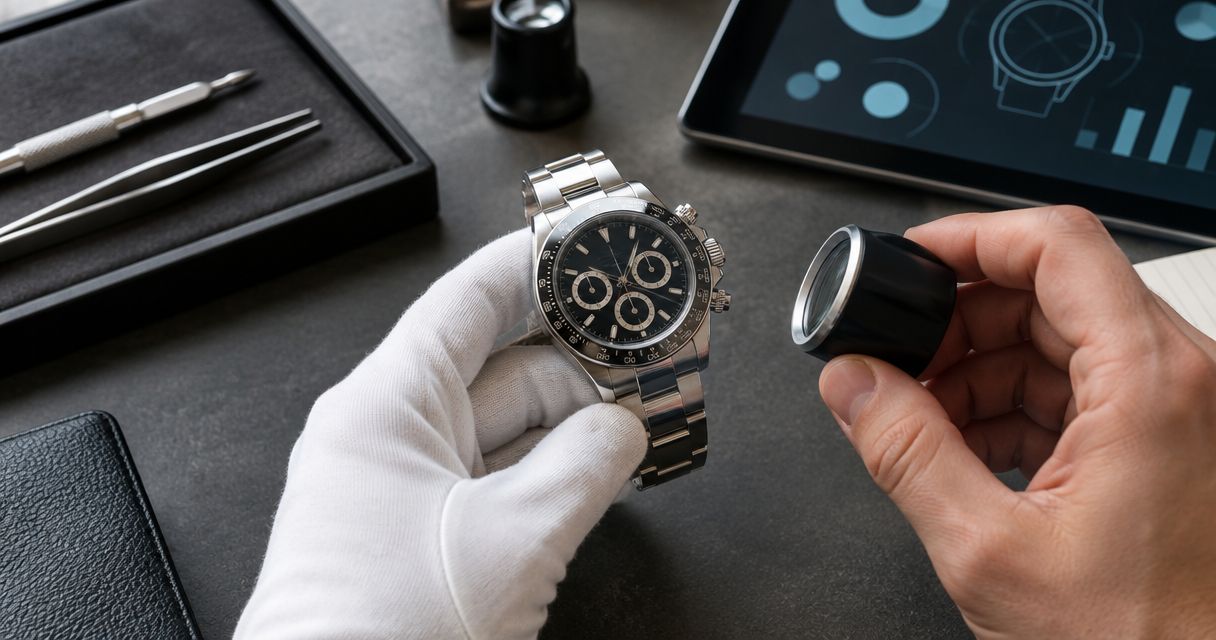
- Specify movement review. Arrange examination of the movement by a qualified professional using appropriate tools. Ask whether the movement is correct for the reference and whether visible components raise concerns.
- Specify component review. Include the dial, hands, bezel, case, bracelet, and clasp. Ask the specialist to separate genuine replacements from aftermarket parts and unexplained mismatches.
- Specify function and condition review. Request chronograph operation, winding and setting checks, and an assessment of issues requiring service. Ask separately about water-resistance testing if you intend to expose the watch to water.
- Request written findings. Have the report identify the inspected watch, inspection date, areas examined, conclusions, and limitations.
Expected result: You receive findings about this physical watch, including what was verified and what remains unresolved. A vague statement that it “looks good” is insufficient.
Keep these stages distinct: Identity review, Movement review, Component review, and Written findings. That sequence prevents a cosmetic pass from becoming an unsupported purchase decision.
Set the transaction conditions
- Agree on inspection access before commitment. Clarify who holds the watch, who selects the specialist, and whether case opening is permitted.
- Record the seller's representations. Put authenticity, disclosed modifications, included documents, and the watch's identifying information in writing.
- Clarify the remedy for conflicting findings. Ask what happens if the specialist finds counterfeit components, undisclosed alterations, or an identity mismatch. Obtain the applicable terms before relying on them.
- Confirm the delivered identity. Compare the received watch and documents with the evidence file through an appropriate private verification process.
For a 2026 purchase, save a dated copy of the terms you accepted. Do not assume an authentication promise also covers originality, mechanical condition, or future servicing.
Expected result: Inspection findings connect to an identifiable watch and a documented transaction. You know what happens if the evidence contradicts the description.
Authenticate a Daytona when taking it in trade
A trade-in changes the transaction, not the authentication standard. Luxury Time NYC buys and trades luxury watches, so a collector considering an exchange should keep the incoming Daytona's inspection separate from the outgoing watch's assessment.
- Create separate files. Record the identity and condition of both watches. Do not let paperwork for one stand in for evidence about the other.
- Apply the same Daytona checks. Verify the reference, components, documents, movement, and functions of the watch you will receive.
- Document the exchange conditions. Clarify when ownership changes and what happens if inspection reveals an undisclosed issue.
- Approve the incoming watch on its own evidence. A satisfactory assessment of your outgoing watch says nothing about the Daytona's authenticity.
Expected result: You can accept or reject the incoming Daytona based on its own inspection, without confusing that decision with the trade arrangement.
Troubleshooting
- The seller supplies only catalog images. Request photographs of the actual watch and a continuous demonstration video. Do not authorize purchase based on stock imagery.
- The paperwork matches, but the configuration does not. Ask for service documentation and a specialist's component assessment. Resolve whether the discrepancy reflects a legitimate replacement, an alteration, or misidentification.
- The chronograph fails to start, stop, or reset correctly. Stop repeated testing and request professional diagnosis. A malfunction is a condition problem, not proof of either authenticity or counterfeiting.
- The seller refuses movement inspection. Ask why and whether an agreed qualified specialist can perform it. If essential verification remains blocked, do not treat exterior photographs as a substitute.
- The report says only “authentic.” Request the inspected reference, identifying information, component findings, date, and limitations. An unscoped verdict leaves important questions unanswered.
Customize your workflow
Add originality research when collecting a historically significant Daytona. Add condition and water-resistance assessment when buying primarily to wear. Neither changes the need to verify the movement and the watch's identity.
For a 2026 buying file, preserve the inspection report alongside the seller's disclosures and your own acceptance criteria. If you collect across brands, use the Audemars Piguet authentication guide to build a separate, reference-specific checklist rather than copying Daytona details.
FAQ
What's the best way to authenticate a Rolex Daytona before buying?
Combine reference-specific research with a physical inspection by a qualified watchmaker experienced with Rolex chronographs. Verify the movement, components, identifying information, documents, and seller's written disclosures before committing.
Can I authenticate a Rolex Daytona from photos alone?
No, photographs alone cannot establish complete Rolex Daytona authenticity. They help identify inconsistencies and prepare a physical inspection, but they cannot verify hidden movement components.
Do matching box and papers prove a Daytona is genuine?
No, matching box and papers do not independently prove a Daytona is genuine. Reconcile the documents with the actual watch and have a specialist inspect its components.
Does a replacement dial mean a Rolex Daytona is fake?
No, a replacement dial does not automatically make the entire watch counterfeit. A specialist should determine whether it is a genuine Rolex replacement or aftermarket and whether the seller accurately disclosed it.
Should a watchmaker open the Daytona caseback?
A qualified watchmaker should examine the movement when the agreed inspection requires internal verification. Do not open the case yourself; confirm permission, inspection scope, and appropriate testing with the specialist.
Can a serial-number search authenticate a Daytona?
No, a serial-number search alone cannot authenticate a Daytona. An identifier does not establish that the movement and other components are genuine or correct for the reference.
What should I request when buying a Daytona from Luxury Time NYC?
Request the exact reference, photographs of the actual watch, component disclosures, accompanying documents, and written transaction terms from Luxury Time NYC. Confirm the physical inspection arrangements rather than assuming what a retailer's authentication process includes.
One last thing
Passing authentication does not mean passing your collecting criteria. A genuine Daytona with disclosed service replacements can satisfy a wearer while failing a collector's requirement for an original configuration. Write down what you want before inspecting the watch, then judge authenticity, originality, and condition separately.