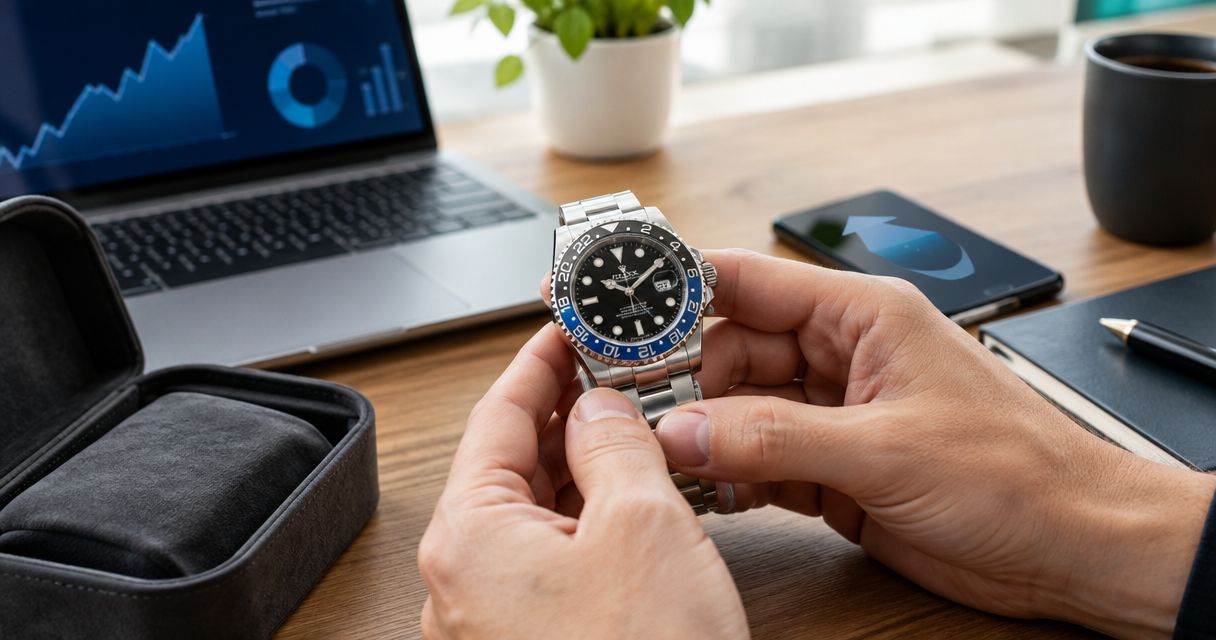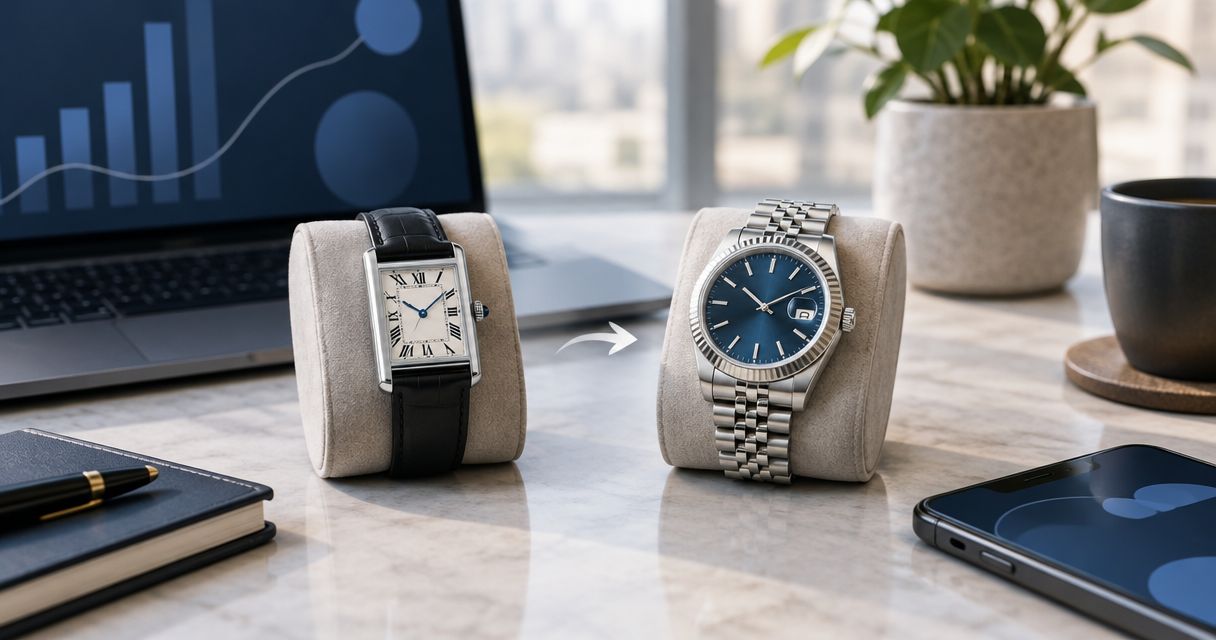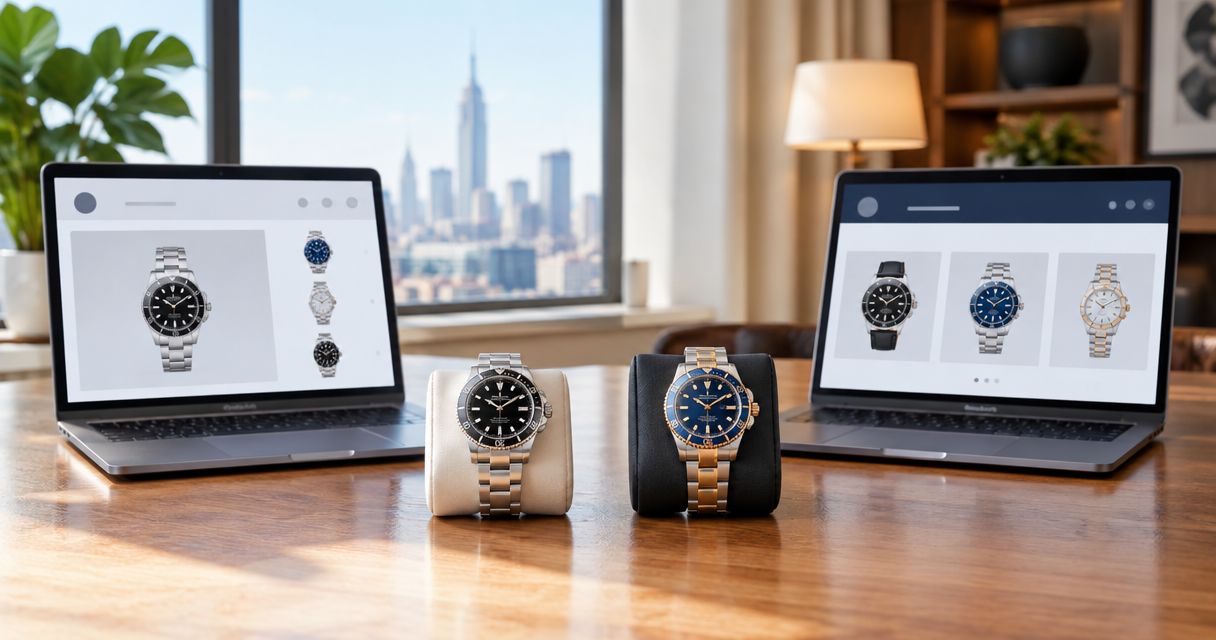
Choose Luxury Time NYC if you want to buy, sell or trade a luxury watch; choose Jomashop if you want to browse watches alongside a broader range of fashion and accessories. This 2026 comparison separates collector-focused shopping from general retail browsing, then explains how to compare the actual watch and transaction terms.
- Luxury Time NYC vs Jomashop comes down to collector transactions versus broader retail shopping.
- Luxury Time NYC is the better fit for luxury watch buyers who also want to sell or trade.
- Jomashop wins for browsing watches alongside fashion and accessories.
- Neither retailer wins automatically on condition, warranty or purchase terms; compare the specific watch.
Why this matters
A luxury watch purchase involves more than choosing a retailer. You are choosing a particular reference, its condition, its accompanying documents and the terms attached to that transaction. A familiar model name does not make two listings equivalent.
Your starting point matters just as much. A collector replacing an existing Rolex has a different task from a shopper exploring watches, sunglasses and fragrances. Choose the retailer around your transaction first, then judge the individual watch.
For a 2026 purchase, use current written information rather than an old review or a general promise. Condition, included accessories and coverage need to match the watch you intend to buy.
At a glance
| Dimension | Luxury Time NYC | Jomashop |
|---|---|---|
| Best for | Collectors buying, selling or trading luxury watches | Shoppers browsing watches and other retail categories |
| Shopping breadth | Luxury-watch-focused business | Watches alongside fashion and accessories |
| Collector focus | New and pre-owned watches, including Rolex, Audemars Piguet, Patek Philippe and Omega | Broader watch and retail browsing |
| Selling or trading | Buying and trading timepieces are stated services | Evaluate any proposed transaction separately from a watch purchase |
| Reference matching | Exact configuration still needs checking | Exact configuration still needs checking |
| Condition and documentation | Judge the individual watch and its accompanying records | Judge the individual watch and its accompanying records |
| Purchase protections | Read the terms attached to your purchase | Read the terms attached to your purchase |
| Pricing model | Individual watch purchases, plus separate selling or trading discussions | Individual retail-item purchases |
| Standout feature | Buy, sell and trade within a watch-focused business | Cross-category shopping |
The table is a decision map, not a claim that every watch from one retailer beats every watch from the other. The collector-focused business wins on transaction fit; the broader retailer wins on shopping breadth. Reference matching and written purchase terms remain essential with either choice.
Jomashop wins for broader retail browsing
Best for: the cross-category shopper. Jomashop is the better starting point when your shopping session extends beyond a luxury watch. Its retail scope includes watches, fashion and accessories, so you can explore different purchase categories within the same business.
That breadth is useful when you have not settled on a watch brand or when you are shopping for different kinds of gifts. Your task is discovery, not necessarily replacing a specific piece in a collection.
The limitation is relevance. A broad retail assortment does not answer whether a particular pre-owned watch has the condition, documentation or configuration you want. Once you identify a candidate, stop judging the retailer by category breadth and start judging the watch itself.
The watch specialist is less aligned with this cross-category task because its stated business centers on luxury timepieces. That focus is useful for collectors, but it is not a reason to choose it when you want a general fashion-shopping destination.
The watch specialist wins for collection-focused transactions
Best for: the collector with a defined next purchase. Luxury Time NYC's luxury-watch business includes new and pre-owned pieces from Rolex, Audemars Piguet, Patek Philippe and Omega, together with buying and trading timepieces. That business model fits a collector deciding what to acquire, retain or move out of a collection.
The advantage is alignment with your task. You can approach the purchase as a collection decision rather than an isolated retail item. Tell the retailer which reference you want, what you already own and whether selling or trading is part of your plan.
That focus does not establish a better outcome for every transaction. You still need a clear description of the proposed watch and separate written terms for anything you are selling or trading. A specialist label is not a substitute for those details.
Jomashop remains a sensible option for a straightforward watch-shopping task. Its broader retail identity becomes less relevant when you already know the precise reference you want; at that point, compare the individual offers rather than the storefronts.
The watch specialist wins when selling or trading is part of the plan
Best for: the owner changing an existing collection. Buying and trading timepieces are explicitly part of the specialist's services. That makes it a direct starting point if you want to discuss your current watch and your next purchase together.
Keep the decisions separate until you understand them. Ask for the assessment of your existing watch, the proposed purchase details and the explanation of how the transaction would work. Do not let an attractive replacement distract you from the terms attached to your outgoing piece.
Use these questions to frame the conversation:
- What information and photographs are needed to assess your watch?
- Which condition findings affect the proposed transaction?
- What documents and accessories should accompany your watch?
- How are the sale or trade and the replacement purchase documented?
- What must happen before you commit to either side?
For a practical example, read the Omega-to-Rolex trade-in workflow. Use it to organize your questions, not as a substitute for the terms of your own transaction.
A purchase listing at Jomashop answers a different question: whether you want to buy that item. Do not assume that buying a replacement also settles what to do with your current watch. Treat any selling or trading arrangement as its own agreement.
Neither retailer wins on reference matching without an exact comparison
Best for: any buyer who already knows the desired configuration. Compare reference numbers, materials, dial details and bracelets before treating two watches as alternatives. A shared collection name is only the beginning.
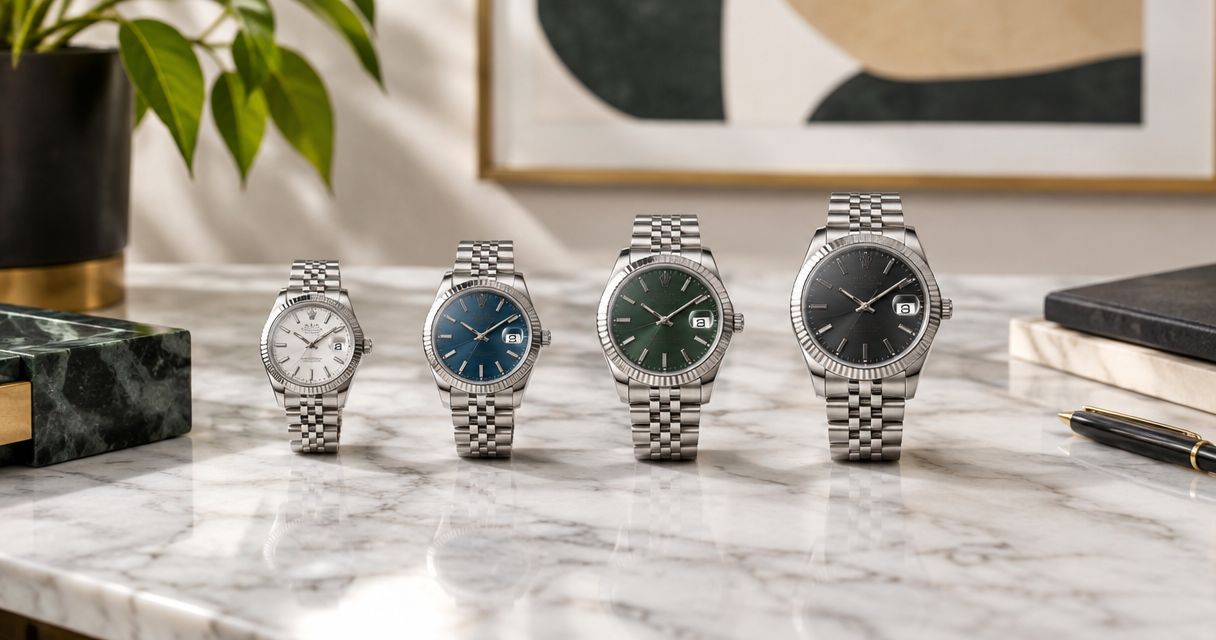
The supplied specialist catalog illustrates the distinction. The Rolex Datejust 41 reference 126300 has a 41 mm stainless-steel case, a mint-green index dial, a smooth bezel and a Jubilee bracelet. The supplied Datejust 36 reference 126234 titles describe white gold/steel, a mint-green index dial and a fluted bezel, with separate Oyster and Jubilee bracelet configurations.
Those are not interchangeable descriptions. If you want the smooth-bezel configuration, a fluted-bezel listing does not answer the same request. Likewise, the bracelet is part of the choice, not a detail to discover after purchase.
Case dimensions also deserve attention. The supplied Audemars Piguet Royal Oak Quartz reference 67650ST.OO.1261ST.01 description gives a 33 mm case and 7 mm thickness. Those measurements describe a different wearing proposition from the supplied 41 mm Datejust; they do not create a retailer-level winner.
For your 2026 shortlist, make an exact-match worksheet. Record the reference, dial, bezel, bracelet and materials for each candidate. Neither retailer wins this dimension until the watches you are comparing actually match your brief.
Neither retailer wins on condition and documentation by name alone
Best for: the pre-owned buyer protecting against an incomplete description. Condition belongs to the individual watch. Do not infer it from the retailer's reputation, the collection name or photographs of a similar piece.
Ask for current photographs of the watch you would receive. Review the case, bezel, crystal, bracelet and clasp, then ask for clarification where an image does not answer your question. If service history or replacement components matter to you, request a written explanation.
Documentation needs the same precision. A statement that a watch includes box and papers should lead to a description of those items. It should not become an assumption about every document you expect.
Use this checking sequence with either retailer:
- Reference match: confirm the exact model and configuration.
- Condition review: examine current photographs and written disclosures.
- Document check: establish which records and accessories accompany the watch.
- Written terms: keep the purchase conditions with your transaction records.
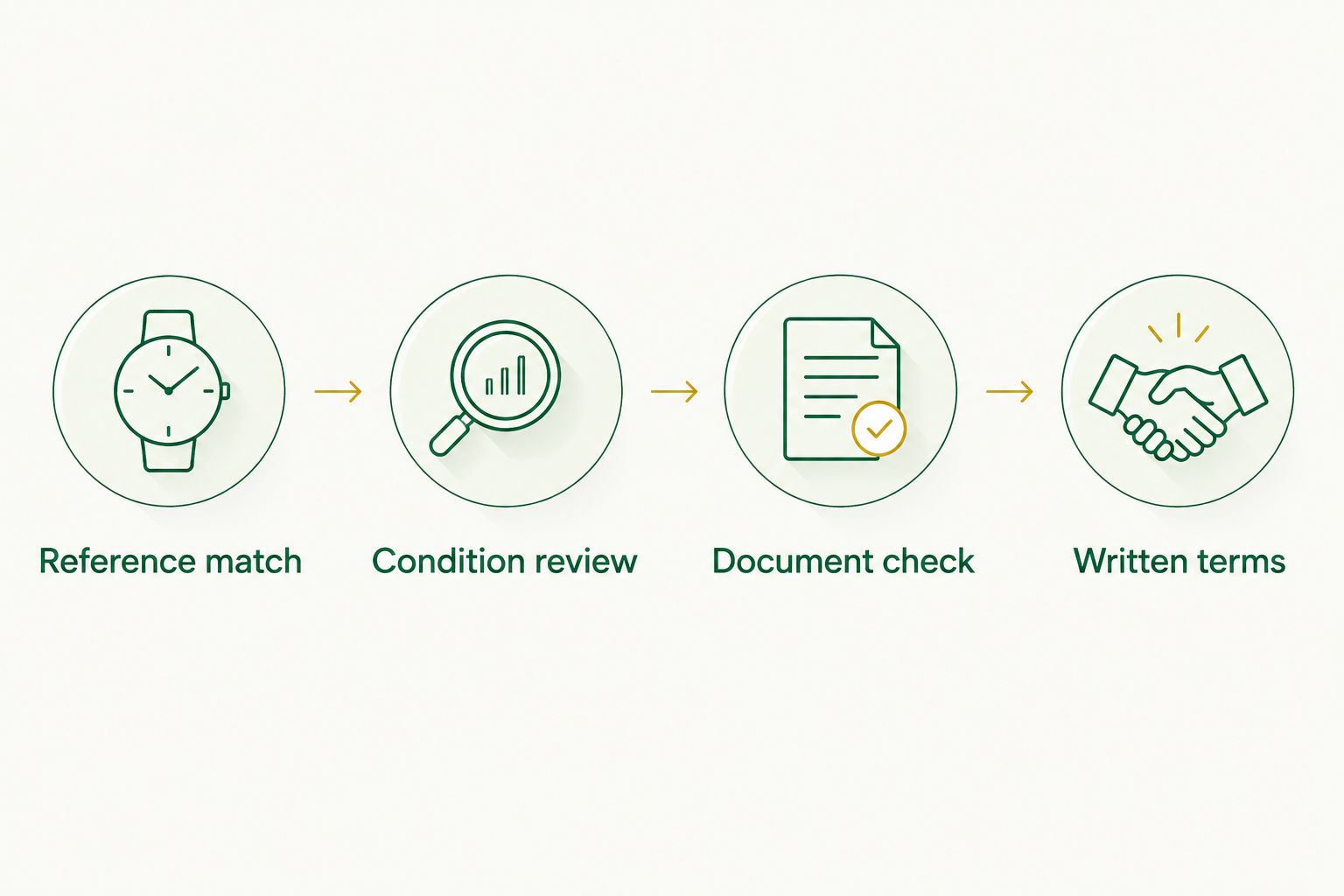
This process gives you a usable comparison. A listing with attractive photography but unresolved condition questions is not equivalent to a watch whose details you understand. Apply the same standard to both businesses.
Written protections matter more than a retailer-level winner
Best for: the buyer who wants clear responsibility after purchase. Authentication language, warranty coverage, return conditions and delivery arrangements address different issues. Read them separately.
An authenticity statement concerns what the watch is. Warranty terms concern the specified coverage. Return conditions govern the circumstances under which a purchase can be reversed. None should be treated as shorthand for the others.
Before committing, ask:
- Who provides any stated warranty, and what does it cover?
- Which exclusions apply to the particular watch?
- What return conditions apply to your transaction?
- What happens if the delivered watch differs from its description?
- What delivery and insurance arrangements are documented?
For a 2026 purchase, keep the applicable terms with your order records. Do not rely on a remembered policy from a previous transaction or another buyer's experience.
There is no automatic winner on protections. Choose the offer whose written conditions meet your requirements, even if the other retailer better matches your general shopping style.
Pricing models: separate the purchase from the collection decision
Both businesses support individual watch purchases rather than a subscription-based buying model. The specialist also buys and trades timepieces, adding a separate transaction path for owners changing their collections.
For a straightforward purchase, predictability comes from knowing exactly what the transaction includes. Establish the watch's configuration, condition, accompanying items and applicable purchase terms before making your decision. A comparison between mismatched watches does not tell you which offer is better.
For a sale or trade, flexibility comes from having another way to restructure your collection. The tradeoff is that you must evaluate your outgoing watch and incoming purchase separately. Ask for a written explanation rather than treating the combined transaction as a single unexplained outcome.
Neither pricing model establishes that one retailer is always the better-value choice. Compare like-for-like watches, then compare the full transaction. That is the useful pricing discipline for 2026, whether you are buying your first luxury watch or replacing a collection piece.
Final verdict: choose around your actual task
Choose Luxury Time NYC if you are a collection-changing owner
You know which luxury watch you want, or you want to discuss buying alongside selling or trading an existing piece. The specialist's stated business matches that task directly.
Luxury Time NYC is the better fit for luxury-watch collectors who want to buy, sell or trade. Still require exact watch details and written transaction terms; business fit does not remove purchase checks.
Choose Jomashop if you are a cross-category retail shopper
You want to explore watches alongside fashion and accessories, or your shopping task is broader than managing a watch collection. Jomashop wins on that browsing scope.
Choose a watch there only after checking the actual configuration, condition and applicable terms. Retail breadth helps you discover options; it does not make those options equivalent.
One-glance scorecard
| Dimension | Winner |
|---|---|
| Best for collection-changing owners | Watch specialist |
| Shopping breadth | Jomashop |
| Collector-focused business model | Watch specialist |
| Stated buying and trading services | Watch specialist |
| Exact reference matching | Tie: verify the specific watch |
| Condition and documentation | Tie: inspect the individual offer |
| Purchase protections | No automatic winner: compare written terms |
| Pricing model | Task-dependent: purchase versus sale or trade |
| Cross-category standout feature | Jomashop |
FAQ
Is Luxury Time NYC better than Jomashop?
Luxury Time NYC is the better fit when buying, selling or trading a luxury watch is your main task. Jomashop is the better fit for browsing watches alongside fashion and accessories. Neither automatically wins on the condition or terms of an individual watch.
Which retailer should I choose if I want to trade my watch?
Start with the watch specialist because buying and trading timepieces are stated services. Request separate written details for your existing watch and the proposed replacement before committing.
Is Jomashop better for browsing different kinds of products?
Yes, Jomashop is the better fit for cross-category retail browsing. Its scope extends beyond watches to fashion and accessories, while the specialist's stated business centers on luxury timepieces.
How do I compare the same Rolex at both retailers?
Match the exact reference and configuration before comparing the offers. Check the dial, bezel, bracelet, materials, condition and included documents; the same collection name alone is not enough.
Does a watch coming with box and papers settle the purchase decision?
No, box and papers do not replace a condition review or clear purchase terms. Establish which items accompany the watch and assess the watch itself separately.
Which retailer has better warranty and return terms?
Choose based on the written terms attached to the particular purchase, not a general retailer ranking. Confirm the coverage provider, exclusions, return conditions and process for a watch that differs from its description.
What should I check before buying a luxury watch in 2026?
Confirm the reference, review condition, identify the included documents and retain the written purchase terms. For a sale or trade, document the outgoing watch separately from the replacement purchase.
One last thing
Ask for a written description of the exact watch you would receive before making your final choice. Then compare that description with the photographs and purchase terms.
The strongest offer is the one you can describe precisely. If you cannot explain the reference, condition, included items and transaction conditions, keep asking questions—regardless of which retailer you prefer.