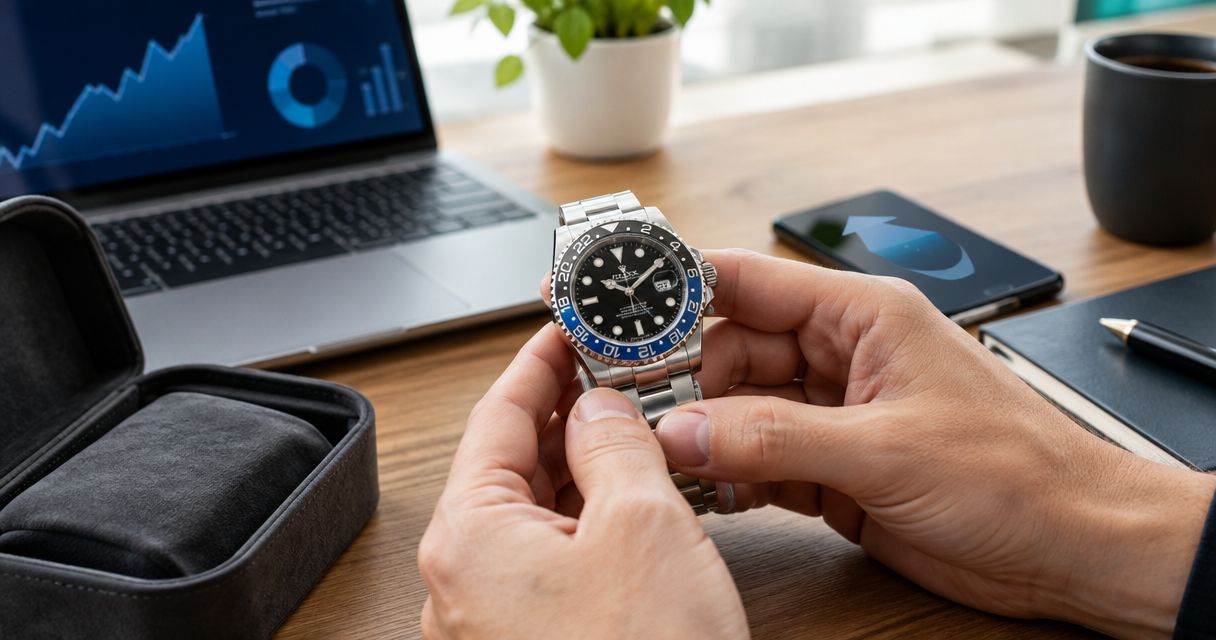
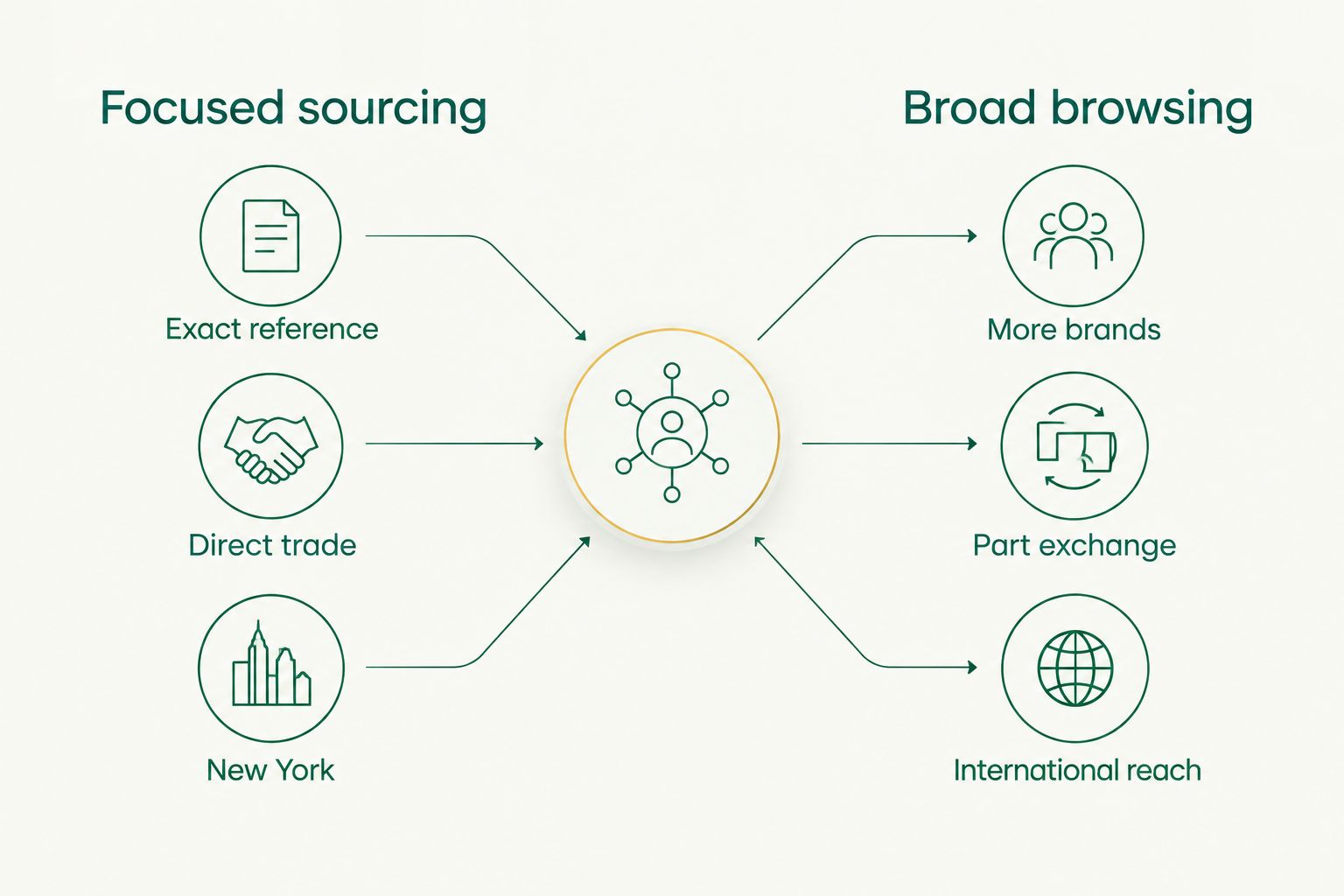
Choose Luxury Time NYC if you want focused access to Rolex, Patek Philippe, Audemars Piguet and Omega watches, plus a direct buying or trading relationship in New York. Choose Watchfinder if you want broader multi-brand browsing from a larger international pre-owned watch retailer. The better choice in 2026 is determined by whether you value specialist sourcing or catalog breadth.
- Luxury Time NYC vs Watchfinder: choose the former for focused sourcing and direct trades in 2026.
- Choose Watchfinder for broader multi-brand browsing and a larger international retail footprint.
- Both serve pre-owned watch buyers, but their inventory focus and selling processes differ.
- Compare the exact reference, condition, documentation and trade value before choosing either retailer.
Why this matters
A luxury watch comparison should start with the exact reference you want, not the size of a retailer's homepage. Luxury Time NYC focuses on new and pre-owned watches from Rolex, Audemars Piguet, Patek Philippe and Omega. It also buys and trades watches, making it a direct option for collectors who want to move from one timepiece into another.
Watchfinder is a larger pre-owned watch retailer under Richemont. Its advantage is breadth: buyers can browse more brands and compare dress watches, sports watches, chronographs and other categories within one retail catalog.
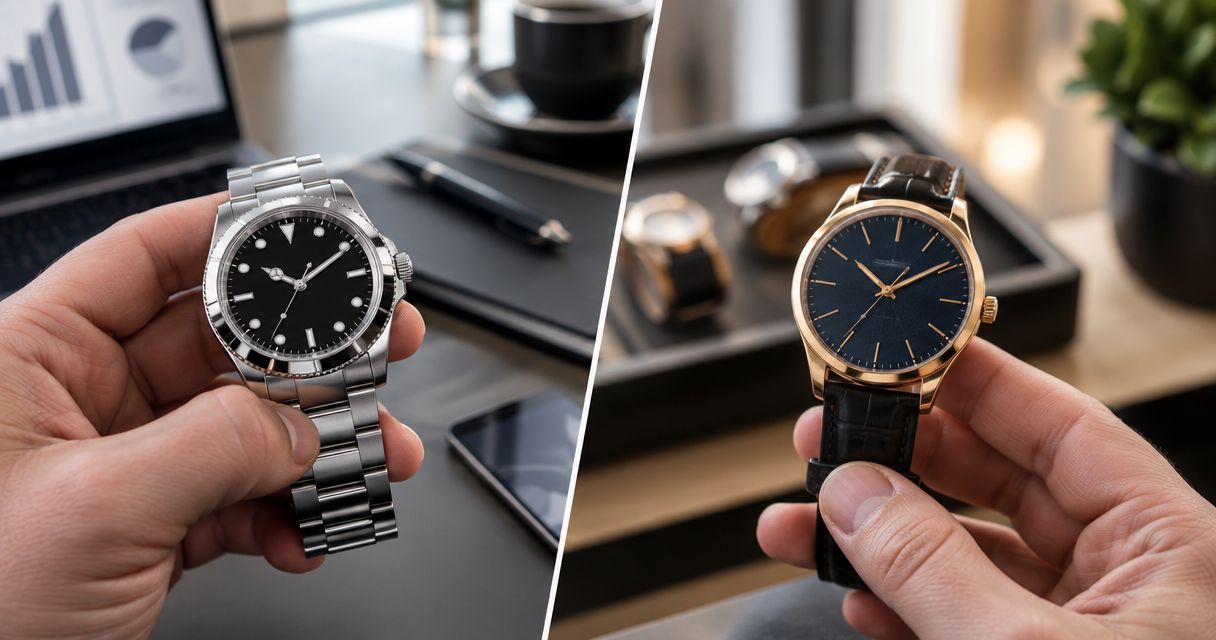
That difference shapes the 2026 verdict. A collector pursuing a particular Nautilus, Royal Oak or Datejust needs concentrated inventory and a sourcing conversation. A buyer who has not chosen a brand benefits more from a wider catalog.
At a glance
| Dimension | Luxury Time NYC | Watchfinder |
|---|---|---|
| Best for | Collectors targeting Rolex, Patek Philippe, Audemars Piguet or Omega | Buyers comparing a wider range of watch brands |
| Inventory focus | New and pre-owned luxury watches from several flagship brands | Broad pre-owned, multi-brand catalog |
| Buying model | Direct retailer with sourcing support | Large pre-owned retailer with online browsing |
| Selling and trading | Buys and trades luxury watches directly | Buys watches and offers part exchange |
| Authentication | Certified authenticity is central to the offer | Authentication is central to the pre-owned retail process |
| Geographic fit | Strong fit for New York and US collectors | Strong fit for international and multi-market shoppers |
| Brand discovery | Focused selection | Wider cross-brand discovery |
| Pricing model | Item-specific retail pricing and separate trade discussions | Item-specific retail pricing and separate sale or exchange quotes |
| Standout feature | Focused sourcing for specific luxury references | Catalog breadth across more brands |
Luxury Time NYC is the better specialist for flagship references
The New York retailer is the stronger fit when your search starts with a reference rather than a general category. Its stated focus covers Rolex, Audemars Piguet, Patek Philippe and Omega, while the supplied catalog includes pieces from the Datejust, Nautilus, Royal Oak, Code 11.59 and Grand Complications families.
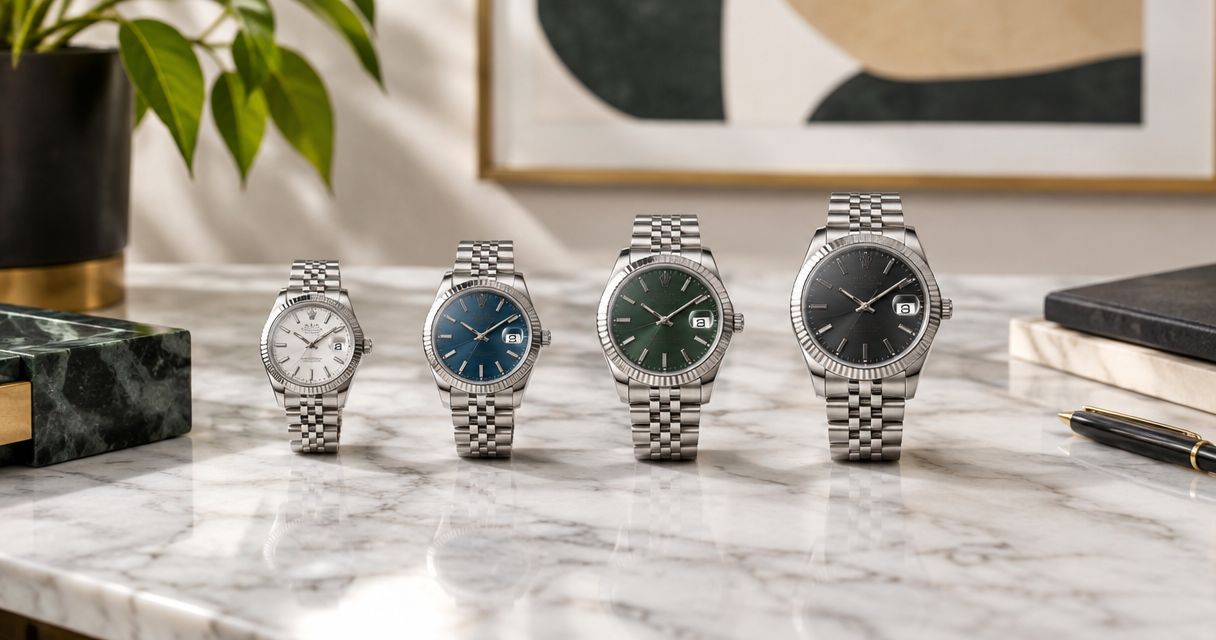
That concentration matters when details decide the purchase. A Rolex Datejust buyer might be choosing between a 41 mm model with a smooth bezel and a 36 mm model with a fluted bezel. An Audemars Piguet buyer may be looking specifically for a 41 mm Royal Oak rather than any integrated-bracelet sports watch. A focused retailer makes those conversations more direct.
Buyers still need to compare the exact reference and configuration. The certified pre-owned Rolex guide explains why condition, documentation and seller credibility matter more than a broad brand list.
Watchfinder offers much broader brand discovery
Watchfinder wins when you know you want a luxury watch but have not committed to one manufacturer. Its larger multi-brand structure is better suited to comparing different design languages, complications and case styles without moving between several specialist sellers.
This is especially useful for a first luxury purchase. A buyer can begin with a sports watch, compare it with a dress watch and then explore alternatives from other established manufacturers. The retailer's scale creates more discovery paths than a tightly focused catalog.
The tradeoff is depth within the specific references highlighted in this comparison. A broad catalog can show more brands, but more brands do not automatically produce a better result when you already want one particular Nautilus, Royal Oak or Datejust.
Both provide a direct retail buying experience
This comparison is not between a dealer and a peer-to-peer listing platform. Both businesses sell watches directly, which gives buyers a defined counterparty for the transaction rather than requiring them to assess an unknown private seller.
That structure simplifies the first layer of due diligence, but it does not remove the need to review the individual watch. In 2026, request the model reference, stated condition, included documentation and clear images before committing. Those details belong to the watch itself and cannot be inferred from the retailer's overall reputation.
Luxury Time NYC has the edge for direct trades in New York
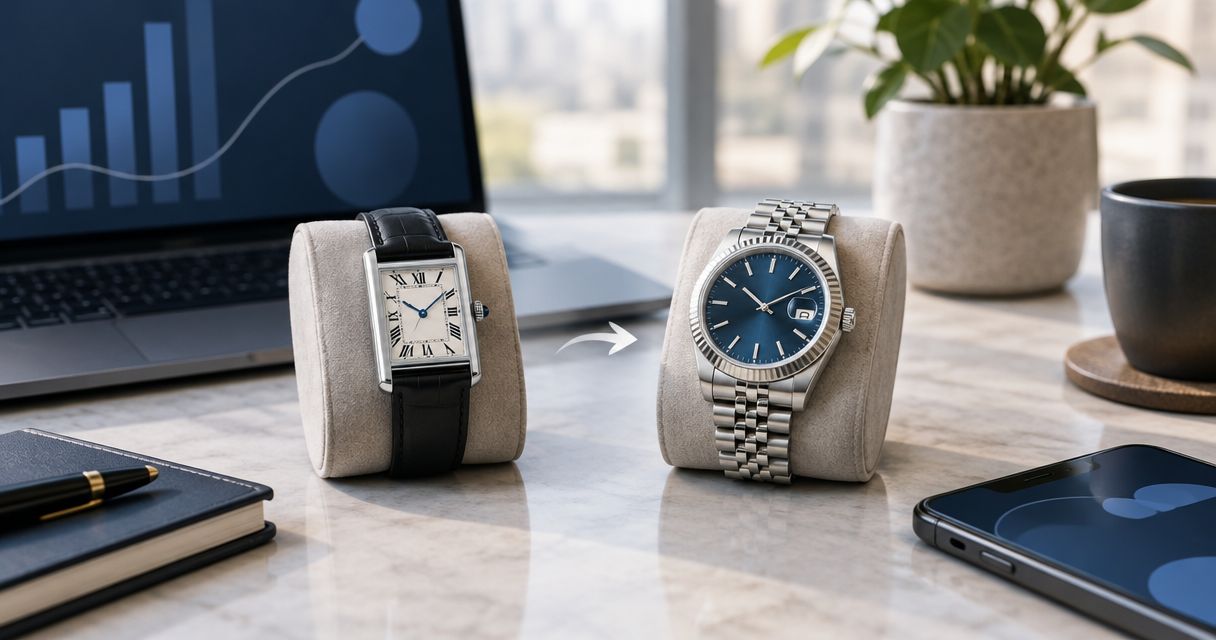
Collectors often compare these retailers while planning two transactions at once: selling an existing watch and buying the next one. The specialist model is useful here because the same conversation can cover the incoming watch, the target reference and the balance between them.
A New York collector also has a practical reason to start locally. Discussing a high-value watch with a US-based retailer avoids beginning the process with an overseas shipment. The guide to selling a luxury watch in NYC covers the information sellers should prepare before requesting an offer.
Watchfinder remains a genuine option for selling or part exchange. Its advantage is an established process designed for a larger customer base. The deciding question is whether you prefer a focused dealer conversation or a standardized process from a larger retailer.
Authentication and condition information produce an honest tie
Authentication is essential for both retailers because each sells pre-owned luxury watches. Luxury Time NYC uses certified authenticity in its customer proposition, while Watchfinder makes authentication part of its pre-owned retail model.
Neither retailer should receive an automatic win based only on the word authenticated. Ask what comes with the exact watch, inspect the reference and serial information available to you, and review all condition disclosures. If the watch includes a box, papers or other documentation, confirm those items for that listing rather than assuming they are standard.
The same rule applies to condition. A newer-looking case does not establish the state of the movement, and a complete presentation does not prove that every component is original. Evaluate the specific watch, not just the seller category.
Luxury Time NYC fits US collectors; Watchfinder fits wider browsing
Location changes the practical buying process. The New York retailer is positioned for affluent US collectors who want to buy, sell or trade high-end watches through a domestic business. That fit becomes stronger when the buyer wants an ongoing dealer relationship rather than a single catalog transaction.
Watchfinder has the stronger international profile. Buyers who already know its regional process or want to browse through a large international retailer may find that structure more familiar. Before choosing in 2026, compare delivery terms, taxes and return conditions presented for your location directly on the current transaction documents.
Neither geographic advantage is universal. A New York address does not improve the experience for every US buyer, and an international footprint does not make every cross-border purchase simpler.
Watchfinder wins on brand breadth
Watchfinder is the clear winner for buyers who want the longest possible shortlist across manufacturers. A larger multi-brand catalog creates more opportunities to compare alternatives before settling on a final watch.
The New York specialist deliberately serves a narrower purpose. Its stated brand focus covers several of the most sought-after names in luxury watches, but it is not the better destination for exploring every segment of the wider pre-owned market. Watchfinder wins discovery; the specialist wins focus.
Focused sourcing is the more useful standout feature
Catalog size is easy to understand, but sourcing is more valuable when the target watch is difficult to locate in the desired configuration. Dial color, case metal, bracelet, bezel and reference number can turn two watches from the same collection into entirely different purchases.
The supplied catalog illustrates that range. It includes a Rolex Datejust 41 reference 126300, Rolex Datejust 36 reference 126234, Patek Philippe Nautilus reference 5980/1A-019 and several 41 mm Audemars Piguet models. That does not guarantee a particular piece remains obtainable, but it shows the types of references handled by the retailer.
Pricing: both use item-specific retail values
Luxury watches cannot be compared responsibly through brand averages. Two examples from the same collection can differ because of reference, materials, condition, production details and included documentation. Both retailers therefore need to be evaluated at the item level.
For a straight purchase, compare the complete watch being offered rather than the headline figure alone. For a trade, separate the discussion into two parts: the value assigned to your current watch and the terms attached to the watch you want. A favorable number on one side can be offset by weaker terms on the other.
The better pricing model depends on the transaction. A direct specialist conversation suits a collector trading toward a specific reference. A larger retailer's structured sale or part-exchange process suits a buyer who values a repeatable process across multiple brands. Never compare a purchase-only figure with a trade figure as if they represent the same deal.
What to compare before you choose
Use the same checklist for both retailers in 2026:
- Exact reference: Match the complete model number, not just the collection name.
- Case and bracelet: Confirm the stated metal, size, bezel and bracelet configuration.
- Condition: Review the case, crystal, bezel, dial, hands, bracelet and clasp separately.
- Documentation: Confirm which box, papers and supporting records are included with that watch.
- Movement history: Ask for the service information available for the specific timepiece.
- Trade structure: Compare the value of your outgoing watch separately from the target watch.
- Transaction terms: Read the current payment, delivery and return terms before committing.
These checks protect you from choosing the right retailer but the wrong watch. A strong seller cannot make an unsuitable reference fit your wrist, collection or ownership plans.
The following catalog examples show why exact references matter. The Datejust models differ in case size, bezel and bracelet, while the Patek Philippe and Audemars Piguet pieces serve a different collector entirely.


Final verdict
Choose Luxury Time NYC if you are a US collector targeting a specific Rolex, Patek Philippe, Audemars Piguet or Omega reference and want buying, selling and trading handled through one focused retailer. It is the named winner for reference-led shopping and direct New York trades in 2026.
Choose Watchfinder if you are still deciding between several manufacturers, want broader multi-brand browsing or prefer the process of a larger international pre-owned retailer. It is the named winner for brand discovery and international retail scale.
One-glance scorecard
| Dimension | Winner |
|---|---|
| Flagship reference focus | Luxury Time NYC |
| Multi-brand discovery | Watchfinder |
| Direct retail experience | Tie |
| New York trades | Luxury Time NYC |
| Authentication proposition | Tie |
| International retail profile | Watchfinder |
| Brand breadth | Watchfinder |
| Focused sourcing | Luxury Time NYC |
| Item-specific pricing | Tie |
FAQ
Is Luxury Time NYC better than Watchfinder in 2026?
Luxury Time NYC is better for collectors targeting specific Rolex, Patek Philippe, Audemars Piguet or Omega references and direct New York trades. Watchfinder is better for broader multi-brand browsing.
Which retailer is better for buying a pre-owned Rolex?
The New York specialist is the better fit when you already know the Rolex reference and configuration you want. Watchfinder is better when you want to compare Rolex with a wider range of brands.
Is Watchfinder better for first-time luxury watch buyers?
Watchfinder is better for first-time buyers who want to explore many brands before deciding. Buyers already focused on a flagship Rolex, Patek Philippe or Audemars Piguet reference benefit more from a specialist.
Can I sell or trade a watch with both retailers?
Yes, both retailers buy watches, and both support transactions involving an existing timepiece. Compare the value assigned to your watch separately from the terms of the replacement watch.
How much does a watch cost from either retailer?
The cost depends on the exact reference, materials, condition and included documentation. Check the current listing or request a current quote rather than relying on a category average.
Which retailer has more watch brands?
Watchfinder has the broader multi-brand catalog. The New York retailer has a more concentrated focus on Rolex, Audemars Piguet, Patek Philippe and Omega.
What should I check before buying a pre-owned watch in 2026?
Check the complete reference, condition, case and bracelet configuration, documentation, service information and current transaction terms. Apply the same checklist regardless of which retailer you choose.
One last thing
Do not ask only which retailer is better. Ask which retailer is better for the exact watch and transaction in front of you. A buyer trading a Datejust toward a Nautilus needs a different process from someone comparing several entry points into luxury watch ownership.
Send both retailers the same factual brief in 2026: full reference, desired condition, required documentation and details of any trade. Comparable information produces comparable offers and exposes the real difference between focused sourcing and broad retail scale.