Musicians’ luxury watch selection is the process of choosing a high-end timepiece with the aim of supporting your performance, public image, and everyday wear. This 2026 guide to luxury watches for musicians puts instrument clearance, camera appearance, and ownership checks ahead of celebrity imitation.
- Choose luxury watches for musicians by wrist comfort and performance clearance, not celebrity associations.
- Rolex Datejust 41 suits musicians seeking a watch for everyday wear and public appearances.
- Audemars Piguet Royal Oak Quartz offers a 33 mm case; check bracelet fit before choosing.
- Luxury Time NYC offers new and pre-owned luxury watches, plus buying, selling, and trading options.
Why luxury watches matter for musicians and entertainers
A watch for a recording session has a different job from a watch for an awards appearance. During a performance, clearance and comfort take priority; during a portrait session, the dial, bracelet, and proportions become part of the styling decision. Choose for the setting where you will actually wear it.
Start with your existing wardrobe and working routine before browsing Luxury Time NYC. The retailer sells new and pre-owned watches from Rolex, Audemars Piguet, Patek Philippe, and Omega, and offers buying, selling, and trading options.
Luxury Time NYC is best for musicians seeking new or pre-owned luxury watches with buying, selling, and trading options. That is a retail fit, not a substitute for checking the exact watch’s condition, dimensions, and terms.
For your 2026 shortlist, separate three decisions: whether the watch works on your wrist, whether it suits your image, and whether its ownership requirements suit your routine. A striking dial cannot correct an uncomfortable bracelet. A famous reference cannot establish the condition of an individual pre-owned example.
Choose your watch in six steps
Define where you will wear the watch
Write down the watch’s main assignment before choosing a brand. Is it for interviews, rehearsals, touring days, premieres, or private collecting? You do not need one watch to cover every setting, and leaving a watch off during performance is a valid decision.
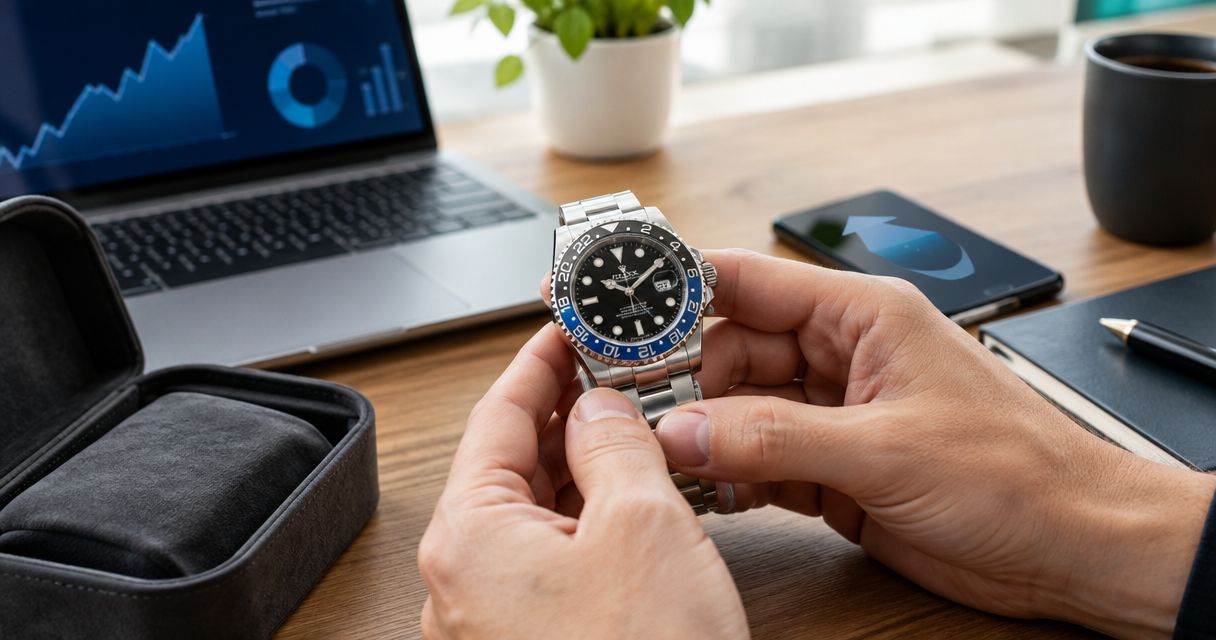
Use your current watch, or a simple borrowed watch, to test the role first. Move through your actual playing position, microphone grip, or choreography rather than judging comfort while standing still. For a guitarist, inspect clearance around the picking hand; for a keyboard player, check the bracelet against the playing position. For an entertainer wearing fitted costumes, include the wardrobe test.
The best performance watch is the one that does not interfere with the performance. If you want a statement piece mainly for arrivals and photographs, make that purpose explicit instead of treating it as stage equipment.
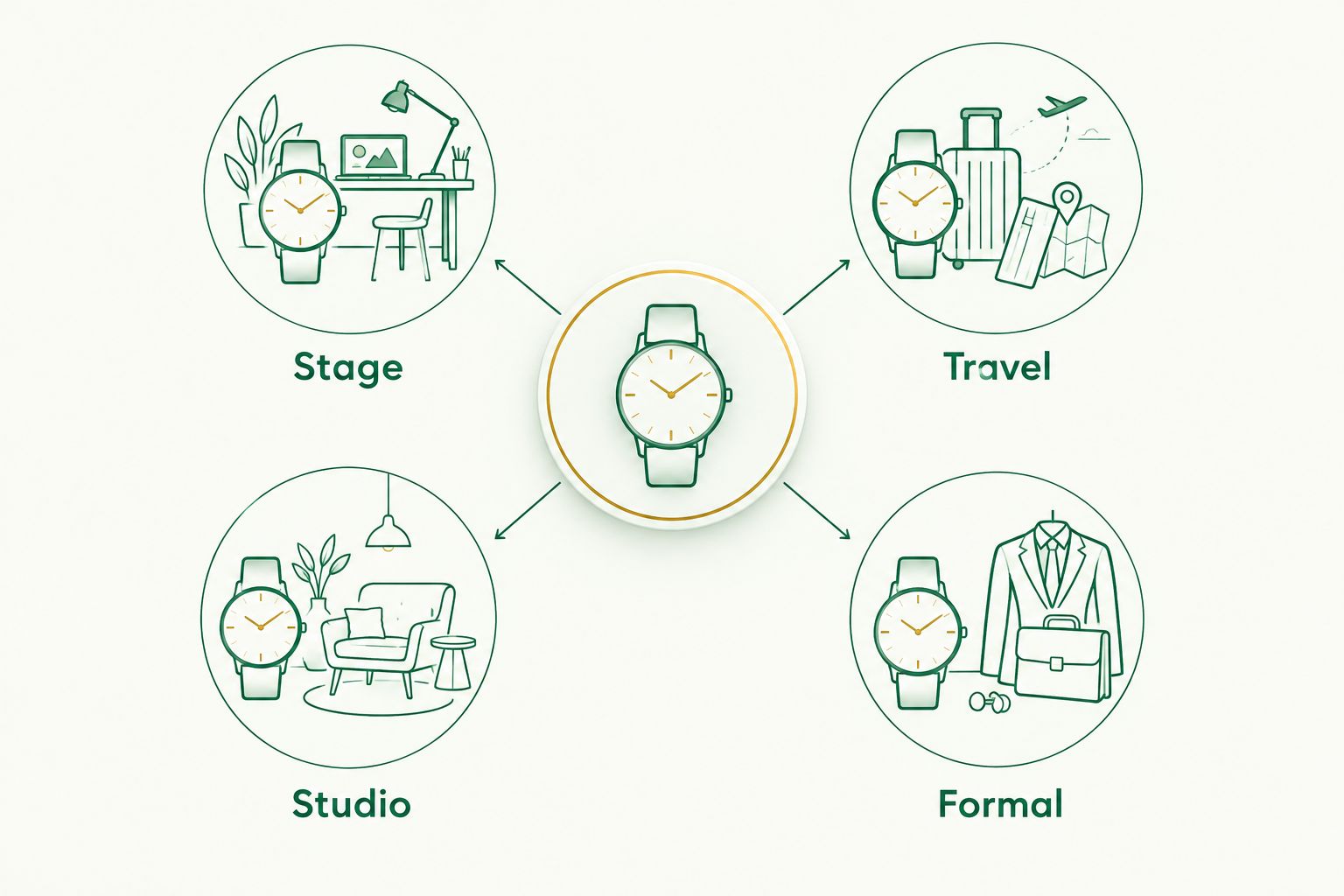
- Name the primary setting: Stage, Studio, Travel, or Formal.
- Mark situations where you will leave the watch off.
- Test your normal instrument or microphone movements.
- Check clearance against sleeves, cuffs, and costume details.
Check case size and bracelet fit
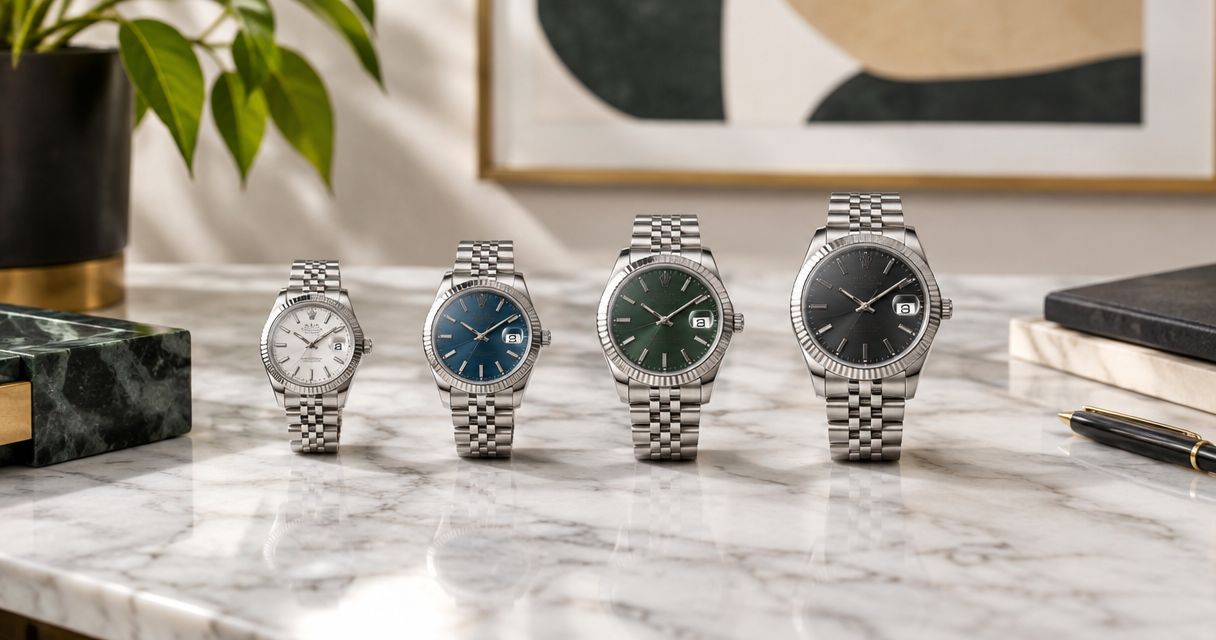
Measure your wrist with a flexible tape, then compare the watch on your wrist rather than using diameter alone. Case thickness, the way the case extends across your wrist, and bracelet adjustment all affect fit. A smaller watch is not automatically comfortable, and a larger watch is not automatically unsuitable.
The supplied Rolex Datejust 41 listing specifies a 41 mm case. The Audemars Piguet Royal Oak Quartz listing specifies a 33 mm case and 7 mm thickness, while the supplied Patek Philippe Calatrava is named as a 38.00 mm model. These measurements are useful starting points, not interchangeable fit guarantees.
For your 2026 comparison, photograph each candidate from normal viewing distance and with your performance outfit. Close-up wrist photographs can make the watch dominate the image. Judge how it sits, whether it shifts, and whether the crown presses into your hand when you move.
- Record your wrist measurement before comparing cases.
- Compare case thickness as well as diameter.
- Ask how the bracelet can be adjusted to your wrist.
- Bend your wrist in your actual performance position.
- Check comfort with the sleeves you wear most often.
Match the watch to your visual identity
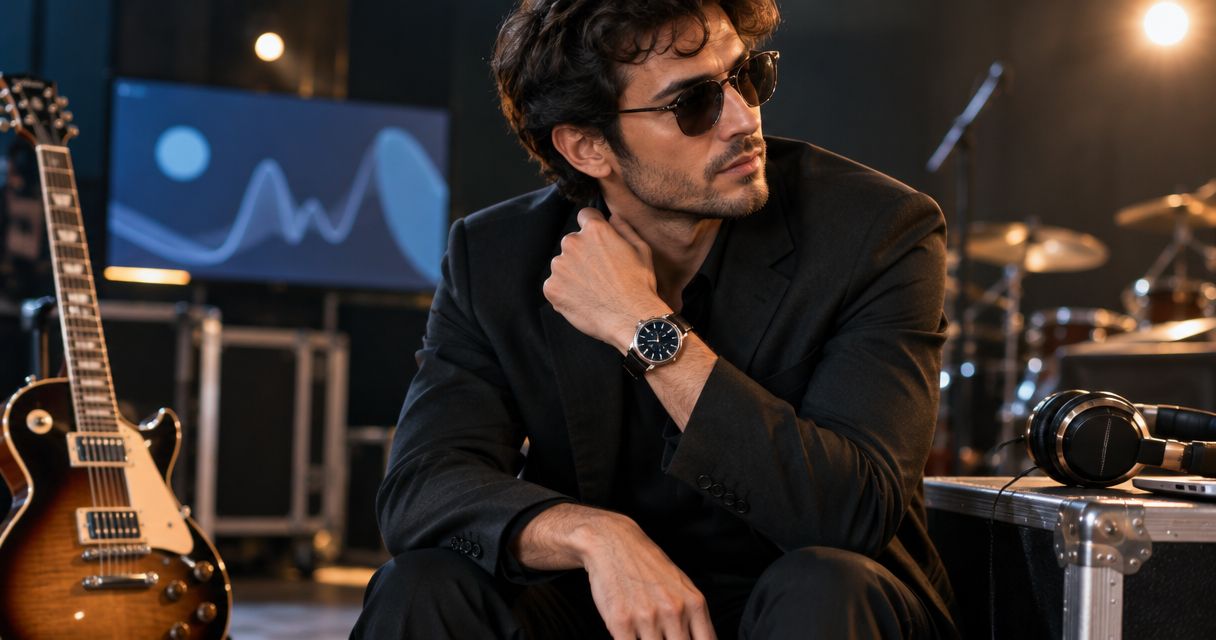
Begin with photographs of your own outfits, not a celebrity watch collection. Choose whether you want the watch to blend into your styling or become a deliberate focal point. Neither approach is better in every setting; the useful choice is the one you can explain in terms of your own wardrobe.
The supplied Rolex Datejust 41 pairs a mint green index dial with stainless steel, a smooth bezel, and a Jubilee bracelet. The supplied Audemars Piguet Code 11.59 pairs a purple dial with rose gold. Those are concrete visual differences you can compare against your clothing without inventing a story about which artists wear them.
Luxury Time NYC provides a retail route once you have narrowed the brief. Give the retailer your preferred dial color, material, size, and intended use, then evaluate the exact proposed watch. Do not replace those requirements with a vague request for something prestigious.
- Choose either Blends in or Stands out as your styling goal.
- Match the metal tone against your usual accessories.
- Compare dial colors beside your stage and formal clothing.
- Take photographs under the lighting you will use.
- Keep personal taste separate from celebrity recognition.
Compare watch types against your routine
Decide which functions you will use before paying attention to complication names. A chronograph is a stopwatch function; a calendar adds date information. Those features create different dial layouts, but neither is a reason to ignore comfort or legibility.
Manual research comes first: read the exact reference information and the manufacturer’s operating instructions. Luxury Time NYC can be your buying route after that research, but a retailer’s product title does not answer every question about an individual watch. Ask for clarification where a description is shortened or internally inconsistent.
For 2026 touring plans, keep scheduling and travel administration separate from collecting. A luxury watch does not replace your itinerary, and a complicated dial is not automatically easier to read backstage. Choose a complication because you enjoy or use it, not because it appears more serious.
- Decide whether you need a stopwatch or date display.
- Check legibility at a quick glance, not just in photographs.
- Read the operating instructions for the exact reference.
- Ask about setting and maintenance requirements.
- Reject unnecessary complexity if it works against your routine.
Verify the individual watch before committing
Evaluate the watch itself, not just the model’s reputation. For a pre-owned example, request clear photographs, a written condition description, and an explanation of what documentation accompanies it. Ask specifically about replacement parts, modifications, and known service history.
New and pre-owned are buying categories, not complete condition reports. The supplied Rolex Datejust 41 description states Brand New and Box & Papers; several other supplied listings use Call For Enquiry for condition. Treat those entries differently and obtain the information relevant to the exact piece you are considering.
Do not treat a box, a polished case, or a familiar dial as proof of authenticity. Establish how the watch is assessed and what purchase terms apply. If you are comparing dimensions, the Rolex Datejust 41 reference guide is a starting point; the individual watch still needs its own checks.
- Request current photographs of the exact watch.
- Confirm the reference number and stated condition.
- Ask what box, papers, and service records are included.
- Clarify modifications and replacement components.
- Read the purchase terms before committing.
Plan storage, insurance, and future changes
Decide what happens when the watch comes off. Rehearsal rooms, dressing areas, and travel bags require a deliberate storage plan; do not buy first and improvise later. Keep ownership records separately from the watch and avoid publishing identifying documents in social posts.
Ask an insurer about the situations relevant to your work, including travel, loss, theft, and accidental damage. Obtain the actual policy wording instead of assuming a watch is covered because it is expensive or because another possession is insured. Coverage questions belong before the purchase.
Luxury Time NYC offers buying and trading as well as retail sales. That gives you a route to discuss changing your collection, but it does not establish a future valuation or guarantee an outcome. For your 2026 collection plan, buy a watch you want to wear rather than relying on an eventual trade to justify it.
- Choose a secure place for the watch during performances.
- Keep photographs and ownership documents separately.
- Ask an insurer about your specific travel and work settings.
- Retain service and transaction records.
- Review whether you want to keep, sell, or trade the watch.
Compare options for your shortlist
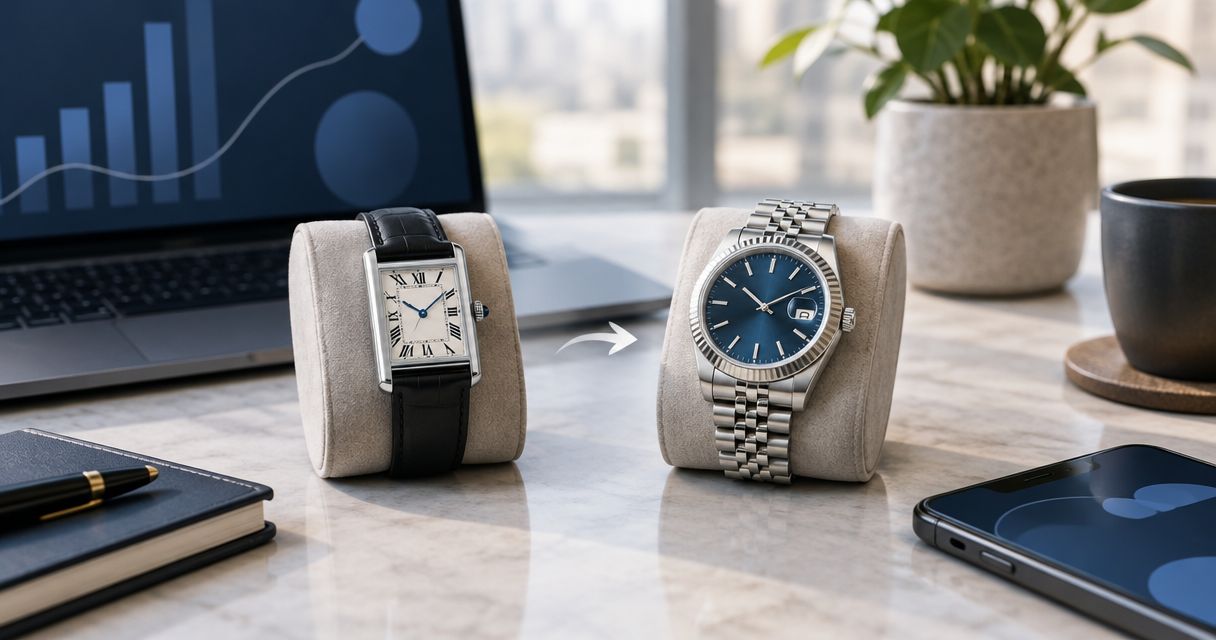
The best option depends on the assignment, not a universal ranking. This 2026 comparison uses details supplied for the individual listings; it does not assume that every watch in a model family shares the same dimensions or configuration.
The Datejust offers a straightforward starting point for everyday styling, while the compact Royal Oak Quartz gives you a smaller case to evaluate. The larger Offshore belongs on a shortlist only when its physical presence is intentional. Each choice has a benefit and a limitation.
| Option | Best for | Main advantage | Key limitation |
|---|---|---|---|
| Rolex Datejust 41, reference 126300 | Everyday wear and public appearances | Mint green dial, smooth bezel, and Jubilee bracelet offer a clear styling direction | The 41 mm case needs a real wrist and sleeve test |
| Audemars Piguet Royal Oak Quartz, reference 67650ST.OO.1261ST.01 | Musicians seeking a compact watch | Listed 33 mm diameter and 7 mm thickness provide a smaller format to compare | Bracelet adjustment and actual comfort still need checking |
| Patek Philippe Calatrava, reference 5296G-017 | Formal appearances and restrained styling | Listed 38.00 mm size and grey dial support a less colorful brief | Condition needs direct enquiry; the model name is not a condition report |
| Audemars Piguet Code 11.59, reference 15210OR.OO.A002KB.02 | Entertainers seeking a colorful focal point | Purple dial and rose gold make the styling choice explicit | The 41 mm format needs checking with cuffs and performance movement |
| Patek Philippe Nautilus Chronograph, reference 5980/1A-019 | Collectors who specifically want a chronograph | Stainless steel, white dial, chronograph, and date match a defined feature brief | Added functions are unnecessary if you want a simple time display |
| Audemars Piguet Offshore Chronograph, reference 26420SO.OO.A029VE.01 | Entertainers deliberately seeking a larger watch | The listed 43 mm format provides a larger option to evaluate | That size needs careful clearance checks before performance use |
These featured examples match different briefs rather than forming a ranked list. Compare their listed dimensions and appearance, then request the individual details needed for your decision. A compact option and a statement option should not pass the same test merely because both are luxury watches.


Common mistakes musicians and entertainers should avoid
Copying a celebrity instead of testing your own wrist
A photograph shows styling, not comfort during your instrument technique or choreography. Build your 2026 shortlist around your own movement and clothing. Borrow the visual inspiration, not the assumption that the same reference suits you.
Buying for the camera and forgetting the performance
A watch that works in a posed portrait still needs a separate performance test. Check microphone handling, instrument clearance, and costume changes. If the watch interferes, reserve it for interviews and appearances rather than forcing it into your working routine.
Treating documentation as the entire authenticity check
Box and papers describe accompanying items; they do not replace assessment of the watch. Ask about the reference, components, condition, and evaluation process. Keep the distinction between original factory configuration and later modifications clear in your decision.
Assuming every impressive watch belongs in a touring collection
Ownership includes storage, insurance, and maintenance decisions. A watch selected for occasional formal wear does not need to become your travel companion. Choose a separate role when that makes the collection easier to manage.
Buying around an imagined resale result
A future sale or trade is a separate transaction, not a promised benefit of ownership. Retain records and understand the condition of what you buy. Choose for use and enjoyment first; assess any later transaction on its own terms.
FAQ
What's the best luxury watch for a musician?
The best luxury watch for a musician is one that fits comfortably and does not interfere with performance. The Rolex Datejust 41 is a starting point for everyday styling, while the supplied Audemars Piguet Royal Oak Quartz offers a smaller 33 mm case to compare.
Should I wear a luxury watch while playing guitar or drums?
Wear a luxury watch while playing only if it passes your movement and clearance checks. Test your actual technique, and leave the watch off if its case or bracelet interferes.
Is a smaller watch better for a performer?
A smaller watch is not automatically better for a performer. Diameter, thickness, bracelet fit, and wrist movement together determine whether the watch suits your work.
Is Rolex better than Audemars Piguet for musicians?
Neither brand is better for every musician. Compare the exact references against your fit and styling requirements; the supplied Datejust 41 and Royal Oak Quartz differ in size and configuration.
Should an entertainer buy a new or pre-owned luxury watch?
Choose new or pre-owned after evaluating the individual watch and its purchase terms. For a pre-owned example, request condition details, information about modifications, and any service records.
Do musicians need a chronograph watch?
Musicians do not need a chronograph to perform. Choose the stopwatch function because you want or use it, rather than treating it as a requirement for a luxury watch.
Should I insure a luxury watch before taking it on tour?
Arrange suitable coverage before taking a luxury watch on tour. Ask the insurer specifically about travel, theft, loss, and accidental damage, and read the applicable policy terms.
One last thing
Test the watch during the least glamorous part of your routine: a rehearsal, a cuff adjustment, or a costume change. That reveals more about daily suitability than an arrival photograph. For a 2026 purchase from Luxury Time NYC, take a written fit-and-use brief into the conversation and keep every candidate accountable to it.