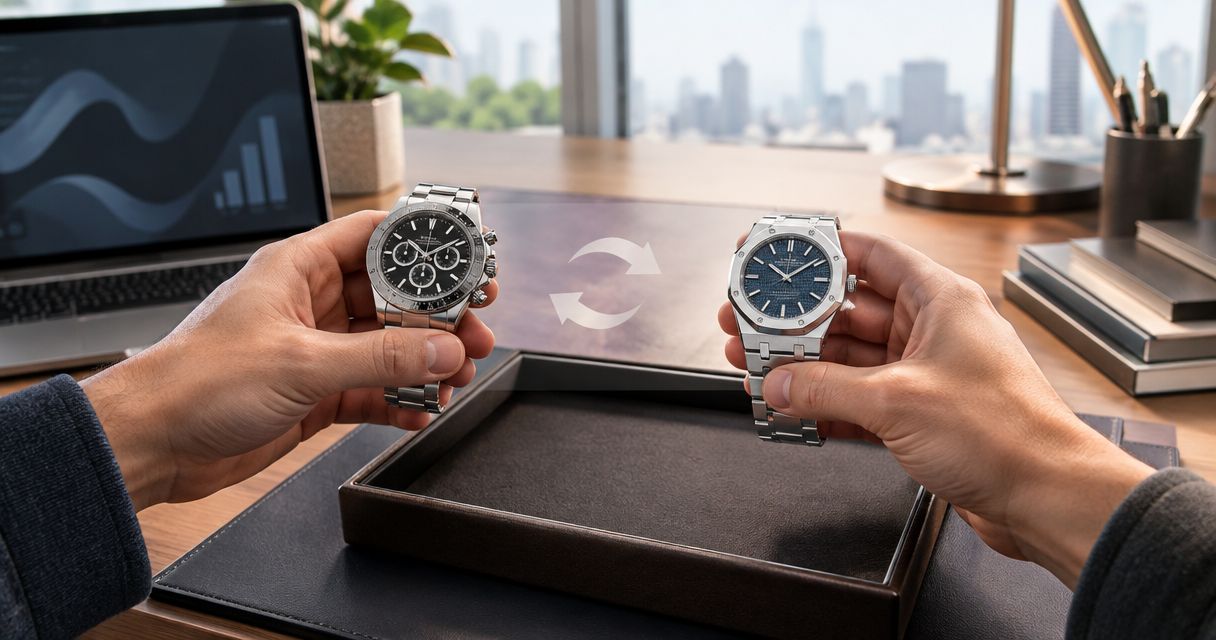
Instead of repeating your Daytona’s details across messages, assemble one reference-specific trade brief, choose the exact Royal Oak you want, and request written terms before handing over your watch. To trade Rolex Daytona for AP Royal Oak in 2026, separate the initial assessment from the final inspection and confirm both sides of the exchange with Luxury Time NYC.
- Luxury Time NYC handles luxury watch buying, selling, and trading; request terms for your exact Daytona and Royal Oak.
- To trade Rolex Daytona for AP Royal Oak, document condition, accessories, and reference numbers before requesting an assessment.
- Choose the Royal Oak’s size, material, and movement before comparing trade terms.
- Confirm inspection conditions and the handover sequence in writing before releasing your Daytona.
Why this matters
A Rolex Daytona and an Audemars Piguet Royal Oak are collection names, not complete descriptions of the watches being exchanged. The reference, configuration, condition, and included accessories belong in the conversation from the start.
Luxury Time NYC is a fit for luxury watch collectors who want a retailer that buys, sells, and trades timepieces. Your next move is to submit a clear brief—not assume that a Daytona automatically exchanges directly for any Royal Oak.
This 2026 workflow keeps your outgoing watch, incoming watch, inspection requirements, and acceptance decision in one record. It is a preparation guide, not a statement of the retailer’s transaction policies; obtain those directly before proceeding.
Before you start
- Prepare ownership and watch records. Gather the reference number, any purchase documentation, service records, warranty card, box, spare links, and accessories you actually have. Keep identity documents and the full serial number out of public posts; provide sensitive information through a channel confirmed with the retailer.
- Prepare photographs and a destination brief. Photograph the Daytona clearly and identify your preferred Royal Oak reference, material, dial, bracelet, and fit requirements. You need access to the watch and its accessories, not a software account or an automated trading setup.
- Resolve the inspection gotcha early. Ask whether the initial assessment is conditional on physical inspection, what can change after inspection, and what happens if you decline revised terms. Do not arrange a handover before those conditions are clear.
Avoid polishing or servicing the Daytona just to prepare an inquiry. First ask what the assessing retailer needs; describe its present condition rather than changing it before that discussion.
Your Daytona trade brief
Record the watch
- Identify the exact reference. Use the reference recorded in your documentation and check it against the watch with qualified assistance where necessary. Record the dial, case material, bezel, and bracelet separately; a collection name alone leaves too much unspecified.
- Describe condition without grading it yourself. Note visible scratches, dents, bracelet wear, missing components, and any known mechanical concerns. Distinguish documented service work from work you remember but cannot support with a receipt.
- Inventory the accompanying items. List the box, warranty card, booklets, service documents, tags, and spare links individually. Mark anything missing or uncertain instead of describing the watch as a complete set without checking.
Photograph the dial, case sides, bezel, bracelet, clasp, and caseback in clear light. Include close-ups of visible damage, and avoid filters that conceal surface condition; the purpose is an accurate preliminary assessment, not a flattering listing.
Use a simple document titled 2026 Daytona trade brief and date each revision. Keep the photographs attached to that version so an older condition description does not follow a newer set of images.
Expected result: You have a reusable record that identifies the Daytona, discloses known concerns, and states exactly what accompanies it. The retailer can ask targeted follow-up questions rather than reconstructing the basics from scattered messages.
Your Royal Oak selection
Define the destination
- Choose the function you want to keep. Decide whether a chronograph remains essential after the Daytona leaves your collection. If you use elapsed-time timing, make that a requirement rather than choosing solely by dial color or material.
- Choose fit before appearance. Specify the case size you want to try, ask about bracelet sizing, and confirm the included links. A case-diameter figure helps narrow the search, but it does not establish how the complete watch will sit on your wrist.
- Name the exact Royal Oak reference. Record material, dial, movement type, condition requirements, and accompanying documents. Separate essential requirements from preferences you are willing to change.
The following Royal Oak examples illustrate different destinations, not interchangeable upgrades. Neither is a recommendation to proceed without inspection and written transaction terms.
| Royal Oak example | Best for | What supports that choice | Trade-off to resolve |
|---|---|---|---|
| Audemars Piguet Royal Oak Quartz, 67650ST.OO.1261ST.01 | Collectors seeking a smaller quartz Royal Oak | The supplied description specifies a 33 mm stainless steel case, 7 mm thickness, and black dial | It does not retain the Daytona’s chronograph function; confirm fit and whether quartz matches your preference |
| Audemars Piguet Royal Oak Chronograph, 26240BC.OO.1320BC.04 | Collectors seeking a Royal Oak with chronograph functionality | The supplied title identifies a 41 mm white gold chronograph with a smoked blue dial | It is a different size and material proposition from the smaller steel example; inspect the particular watch and bracelet |
Choose by reference and intended use, not by brand hierarchy. A collector who wants a smaller watch has a different brief from someone who wants a white gold chronograph, even though both are shopping for a Royal Oak.
These examples give your inquiry a concrete starting point. Ask Luxury Time NYC to confirm the individual watch’s condition, documentation, and transaction terms rather than treating a product title as a complete inspection report.


Expected result: Your destination brief names a specific Royal Oak and explains why it suits your collection. You also know which compromises would make the exchange wrong for you, regardless of the appeal of the Royal Oak name.
Your written trade proposal
Request separate assessments
- Send the briefs together. Use the contact page to ask how to submit your Daytona details and Royal Oak request. Confirm the appropriate channel before sending sensitive documents or a full serial number.
- Ask for separately identified terms. Request the Daytona assessment, the proposed Royal Oak details, any required settlement, and applicable transaction conditions in writing. Keep the outgoing watch’s assessment distinguishable from the incoming watch’s terms.
- Identify every condition. Ask what remains subject to authentication, physical inspection, documentation review, or acceptance. Request the proposal’s date and any stated validity period rather than assuming an earlier discussion remains binding.
A useful inquiry explains that you own the identified Daytona, lists its accompanying items and known issues, and names the Royal Oak reference you want. It then asks for the submission process, inspection conditions, and written exchange terms.
Do not approve a trade from a single headline assessment. You need to understand what you surrender, what you receive, and what must happen before either side considers the exchange complete.
For a 2026 proposal, retain the dated message and every subsequent revision. If an inspection changes the terms, request an updated written version that replaces the earlier proposal explicitly.
Expected result: You can distinguish an initial discussion from an actionable proposal. You know which facts are confirmed, which remain conditional, and what decision the retailer is asking you to make.
Inspection and handover
Confirm the exchange sequence
- Agree on inspection arrangements. Ask who examines each watch, what the inspection covers, and how findings are communicated. Confirm whether replacement parts, refinishing, service needs, or documentation differences require your acceptance before proceeding.
- Confirm custody and transport. Obtain instructions covering the delivery or appointment method, receipt acknowledgment, responsibility during transit, and the procedure if the exchange does not proceed. Verify any insurance arrangements directly; do not assume an ordinary parcel service covers a luxury watch.
- Approve the final record. Check the references, serial identifiers, included accessories, condition disclosures, settlement instructions, and release sequence. Confirm instructions through a trusted contact channel before transferring funds or handing over the Daytona.
The sequence below is a decision checklist, not a promise that every retailer uses the same process. Keep each stage distinct so a preliminary assessment never becomes accidental authorization to complete the trade.
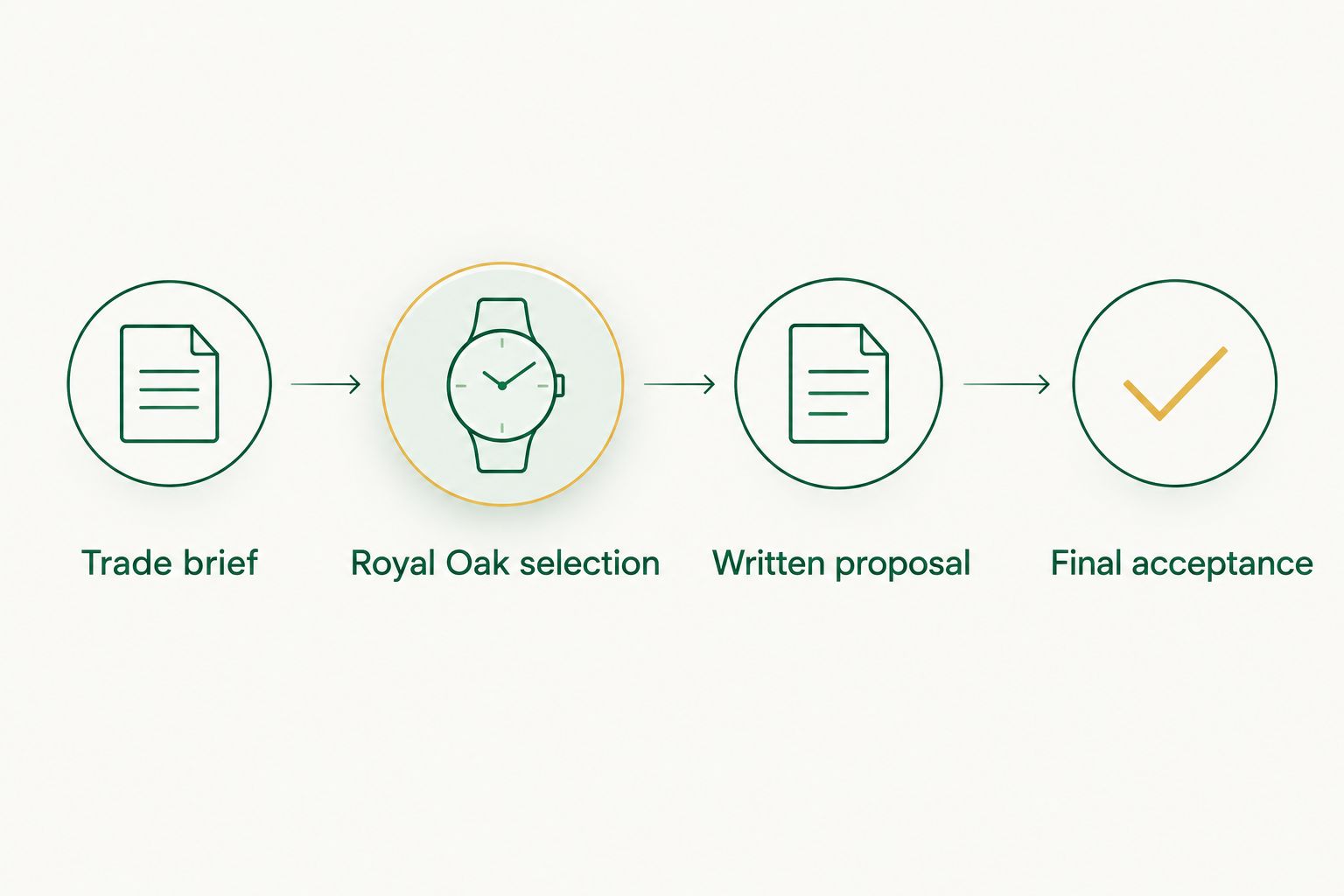
Keep copies of your outgoing-watch photographs, the accessory inventory, correspondence, and the final transaction record. At receipt, compare the Royal Oak and its accompanying items against that record and report discrepancies promptly through the agreed channel.
Expected result: You know when the Daytona changes custody, when you accept the final terms, and how the Royal Oak reaches you. Each decision has a written record rather than an assumption.
When your Royal Oak target changes
Changing the incoming reference creates a revised trade request. Keep the Daytona brief, but replace the destination brief and ask for a new written proposal; do not carry the previous exchange terms across automatically.
Use this adjacent workflow whenever you move from a smaller quartz Royal Oak to a chronograph, change case material, or select a different individual watch:
- State which Royal Oak reference replaces the earlier choice.
- Confirm whether your Daytona’s condition and accessory inventory remain unchanged.
- Request revised terms identifying the replacement Royal Oak.
- Check that inspection, custody, and acceptance arrangements still apply.
Best for collectors still choosing: Keep the inquiry open until the destination is settled. The drawback is additional review, but it avoids accepting an exchange built around a watch you no longer want.
Troubleshooting
The preliminary assessment changes after inspection
Ask for the specific finding and a revised written proposal. Compare the finding with your original condition disclosure, then accept or decline under the previously agreed procedure; do not treat the original assessment as unconditional unless it was expressly stated that way.
You cannot find the original papers
Disclose the missing documents before requesting an assessment. Identify the records you do have and ask what the retailer requires to evaluate ownership and authenticity; missing papers and authentication are separate questions.
The Royal Oak bracelet does not fit
Ask for the included-link inventory and a fit assessment before acceptance. Do not infer wearable bracelet length from the case diameter or assume extra links accompany the watch.
The listed details conflict
Pause if a title, description, photograph, or document identifies a different configuration. Request clarification tied to the individual watch, with updated photographs or records where necessary; a conflicting description is not a detail to resolve after handover.
Settlement instructions change unexpectedly
Verify the change through a contact channel you already trust. Do not rely solely on a new message, attachment, or payment request, and do not release the watch while the instructions remain unresolved.
Customize your workflow
For your 2026 collection plan, add a short acceptance checklist: intended use, wrist fit, chronograph requirement, material preference, and documentation expectations. Mark each item as essential or optional before reviewing a proposal.
Best for an undecided collector: retain the Daytona until the Royal Oak brief is clear. Waiting preserves your current collection, but it does not complete the exchange; use that time to settle the reference rather than repeatedly reopening the same inquiry.
Luxury Time NYC’s luxury watch trading service provides a place to discuss the exchange. The benefit is a retailer offering buying, selling, and trading; the limit is that those services alone do not establish the terms of your particular transaction.
FAQ
Can I trade my Rolex Daytona for an AP Royal Oak?
You can request a Daytona-to-Royal Oak trade assessment from Luxury Time NYC, which buys, sells, and trades luxury watches. Acceptance and final terms require confirmation for the specific watches involved.
Is a Daytona for a Royal Oak always a direct swap?
Do not assume a direct swap. Request written terms identifying both watches and any required settlement before accepting the exchange.
What should I send for a Daytona trade assessment?
Send the reference, clear photographs, a condition description, and an inventory of accompanying documents and accessories. Confirm the submission channel before sharing sensitive identity information or the full serial number.
Can I request a trade without the original box and papers?
You can submit an inquiry that clearly discloses missing box or papers. Ask the retailer what ownership and authentication documentation it requires before arranging an inspection.
Which Royal Oak should I choose after a Daytona?
Choose a Royal Oak chronograph if keeping chronograph functionality is essential. If a smaller quartz watch is your goal, the Royal Oak Quartz reference 67650ST.OO.1261ST.01 is a different direction that requires its own fit and movement decision.
Should I service or polish my Daytona before requesting a trade?
Ask the assessing retailer before commissioning service or polishing. Submit an accurate description of the watch’s current condition and disclose previous work you know about.
When should I hand over my Daytona?
Hand over your Daytona only after inspection, custody, transport, and acceptance arrangements are clear. Keep a written record identifying the watch and every accessory transferred.
One last thing
Count the bracelet links before you count the trade as agreed. A Royal Oak’s case diameter does not tell you whether the particular bracelet fits your wrist, and the incoming watch’s accessory inventory deserves the same attention as the Daytona’s.
Make wrist fit a written acceptance requirement. It turns an easily overlooked detail into a decision you resolve before the exchange, not after it.