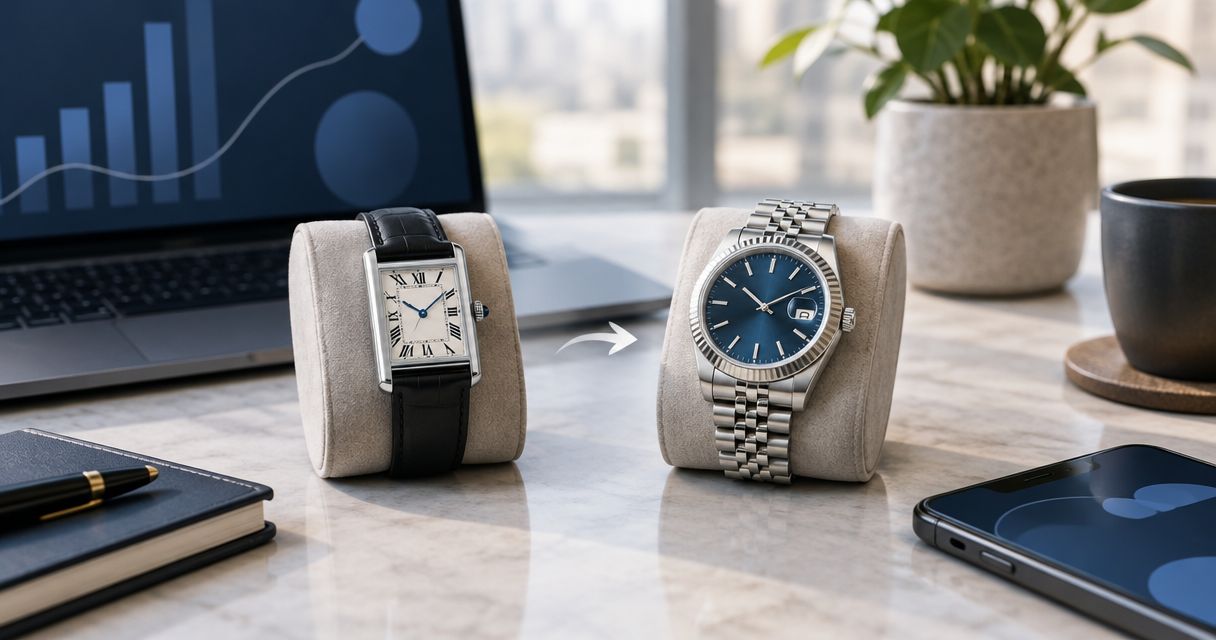
Architects’ luxury watch selection is the process of matching a timepiece’s proportions, readability and construction to your working day, with the aim of choosing a watch you enjoy wearing beyond client meetings. The best luxury watches for architects in 2026 start with wrist fit and a clear design preference—not a professional stereotype.
- Choose luxury watches for architects by wrist fit, dial readability and working conditions—not brand recognition alone.
- Luxury Time NYC serves architects buying, selling or trading luxury watches, including Rolex and Audemars Piguet.
- The Rolex Datejust 41 suits buyers who prefer a larger case and a smooth bezel.
- The Audemars Piguet Royal Oak Quartz suits buyers seeking compact proportions: its listed case measures 33 mm.
Why luxury watch selection matters for architects
A watch for desk work, presentations and site visits needs a clear brief. If your week includes all three, decide which setting governs your purchase rather than expecting one watch to suit every task.
The catalog at Luxury Time NYC includes both restrained everyday designs and elaborate complications. That range makes selection important: an impressive mechanism is not automatically the right choice for a watch worn while sketching, typing or reviewing drawings.
Luxury Time NYC is best for architects who want to buy, sell or trade luxury watches. The retailer offers new and pre-owned watches; your decision still depends on the specific example’s condition, documentation and fit.
For your 2026 shortlist, treat these as separate questions:
- Does the watch sit comfortably during desk work?
- Can you read the dial without studying it?
- Does its visual character suit your own design preferences?
- Do you understand the condition and care requirements?
How to choose luxury watches for architects
Define your working-day brief
Start with a written brief, not a shopping tab. Describe where you will wear the watch, which clothes it must work with and what would make you leave it at home.
A studio-first brief places comfort and readability ahead of ceremony. A presentation-first brief gives you more room to prioritize decorative detail or a distinctive case. For active construction work, follow site rules and remove jewelry whenever the task requires it; a luxury watch is not protective equipment.
Keep function separate from symbolism. You do not need a chronograph because you manage deadlines, and you do not need an elaborate movement because you appreciate engineering. Choose those features because you want to use or enjoy them.
Close your brief with a short list of non-negotiables:
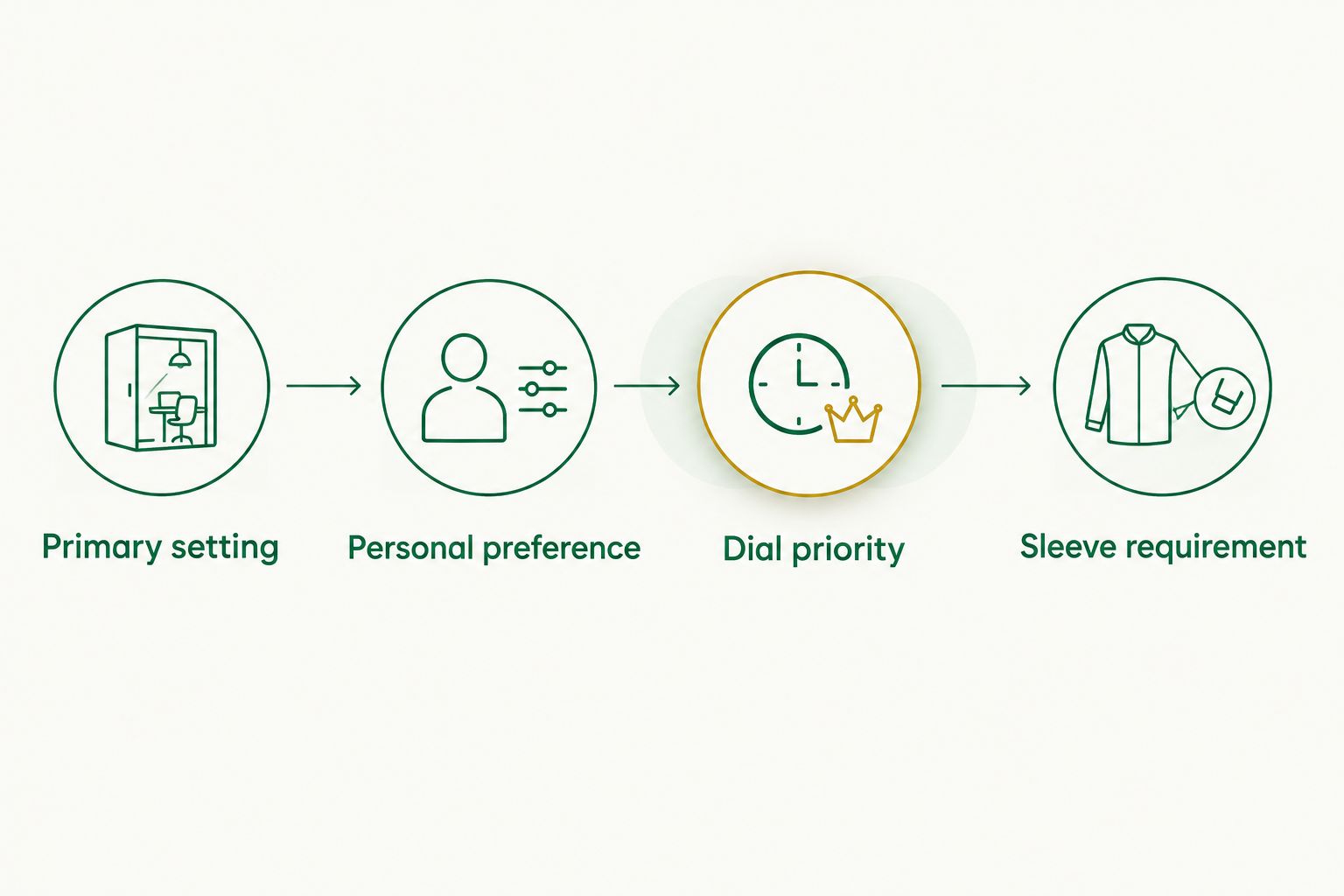
- Primary setting: studio, presentations or off-duty wear.
- Dial priority: quick reading or decorative detail.
- Sleeve requirement: test with your usual shirt or jacket.
- Site boundary: identify tasks when the watch stays off.
- Personal preference: understated, geometric or expressive.
Test proportions before choosing a brand
Use a watch you already own to establish a baseline. Note its diameter, how its ends sit on your wrist and whether the clasp presses against the desk. Then compare candidates in person whenever possible.
Diameter is only the beginning. Case thickness, bracelet shape and the distance between the case’s ends also affect how a watch wears. A close-up wrist photograph is useful, but check the watch from normal viewing distance with your arm relaxed.
The catalog provides several useful reference points: the Audemars Piguet Royal Oak Quartz has a listed 33 mm case and 7 mm thickness; the Rolex Datejust 41 has a listed 41 mm case; an F.P.Journe Chronomètre Souverain example has a listed 40 mm case. These measurements describe different options, not a universal sizing rule.
For your 2026 fitting session:
- Compare the candidate with your familiar watch.
- Bend your wrist into a typing position.
- Rest your forearm on a desk.
- Check the case under your usual cuff.
- View the watch with your arm lowered.
Compare design details by reference
Build a side-by-side shortlist yourself before asking a retailer for guidance. Record the exact reference, dial, bezel, bracelet and case material; a collection name alone leaves too much unresolved.
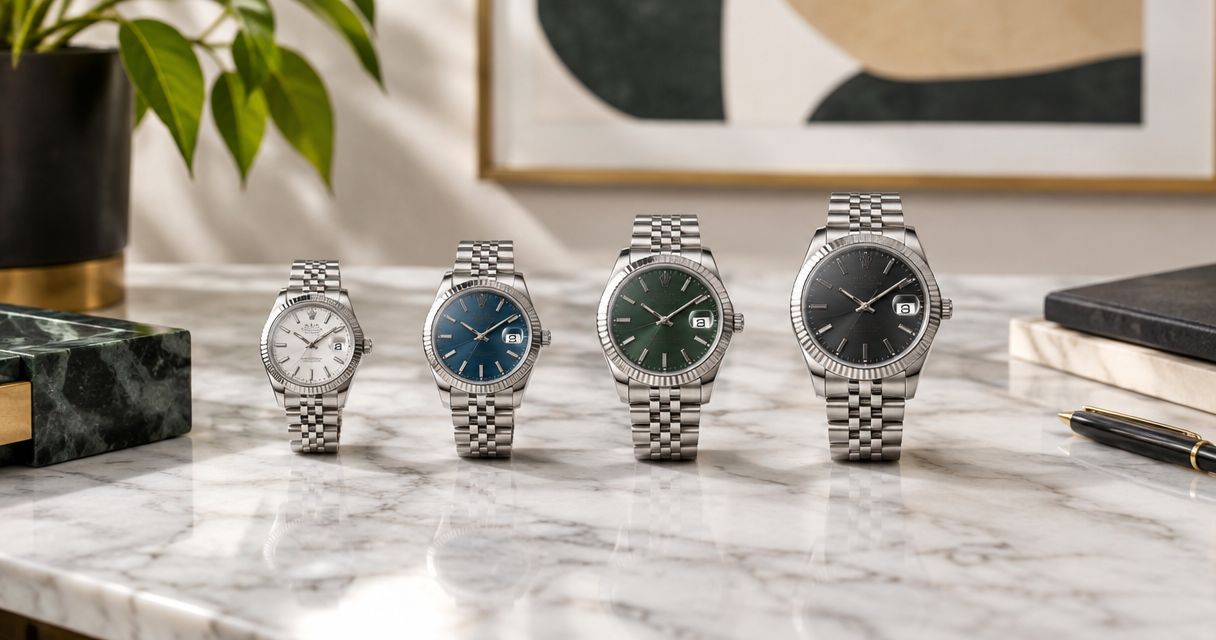
The supplied Rolex Datejust examples show why this matters. The Datejust 41 reference 126300 combines a mint green index dial, smooth bezel and Jubilee bracelet. The Datejust 36 reference 126234 appears with a mint green index dial and fluted bezel, but with either an Oyster or Jubilee bracelet.
Luxury Time NYC luxury watches span those configuration choices. Use the retailer’s catalog to narrow your brief, then ask about the exact watch rather than requesting a generic recommendation for an architect.
Compare the whole composition, not just the dial color. Bezel texture and bracelet construction change the visual balance even when the collection and dial color match.
- Record the full reference and configuration.
- Compare smooth and fluted bezels separately.
- Check bracelet choice on the exact listing.
- View dial photographs under different lighting.
- Separate material preference from brand preference.
Match the movement to your habits
Begin by deciding how much interaction you want. Ask yourself whether setting, winding and learning additional functions are part of the pleasure or simply maintenance you would rather minimize.
Quartz and mechanical watches offer different ownership experiences. Quartz movements use a battery-powered electronic oscillator; mechanical movements use a wound spring. An automatic mechanical movement winds through wrist motion, while a manually wound movement requires winding by hand.
The Audemars Piguet Royal Oak Quartz is the clear quartz option in this guide. Its practical appeal is straightforward timekeeping without a mechanical winding routine; its limitation is equally clear if movement mechanics are central to your interest.
For a 2026 purchase, choose complications only after checking the operating instructions. A calendar or chronograph adds functions, but also gives you more to understand and operate correctly.
- Confirm the movement type for the reference.
- Read the setting instructions before purchase.
- Choose functions you actually want.
- Ask about the watch’s service documentation.
- Avoid operating unfamiliar controls by trial and error.
Inspect the exact watch and its documentation
Start with a written inspection checklist and request clear photographs. For a pre-owned watch, focus on the actual case, bracelet, dial and accompanying documents rather than a general description of the model.
Ask what has been inspected, what supports the authenticity assessment and whether replaced or modified components have been identified. Box and papers provide context, but they do not replace examination of the watch itself.
Luxury Time NYC luxury watches include listings where condition or production year requires an inquiry. Resolve those details before deciding. A missing answer is not a detail to fill with assumptions, and a catalog photograph does not establish the current condition of an individual watch.
Make the documentation match the purchase. Keep the written description, reference details and any stated terms together so you know exactly what you are agreeing to buy.
- Request current photographs of the actual watch.
- Confirm the reference and dial configuration.
- Ask about polishing and replaced components.
- Review any service records provided.
- Confirm exactly which documents accompany it.
- Read the written terms before committing.
Decide how the watch fits your collection
Make the final decision with your existing watches in view. If the candidate repeats a role already covered, be clear about what makes the new watch preferable: fit, material, design or ownership experience.
For a first luxury watch, prioritize a configuration you want to wear frequently. For an established collection, a contrasting case shape or movement type offers a clearer reason to add something new than buying another dial variation by habit.
If you plan to trade, treat the watch you are buying and the watch you are giving up as separate decisions. Luxury Time NYC buys and trades timepieces, but the terms of any transaction need direct confirmation. Do not assume a purchase includes a future resale commitment.
Finish your 2026 decision with these checks:
- State the watch’s role in one sentence.
- Compare it with what you already wear.
- Confirm the exact example’s condition.
- Separate purchase and trade decisions.
- Keep the invoice and supporting records.
The selection sequence is simple: define the job, establish fit, compare configurations, then examine the individual watch. Do not reverse that order because a dial catches your attention.
Compare watch options for architects
These are use-case recommendations, not a ranking of craftsmanship or financial potential. The Rolex Datejust options are the starting point for comparing everyday proportions; the Royal Oak Quartz and Chronomètre Souverain suit more specific preferences.
| Option | Best for | Main advantage | Key limitation |
|---|---|---|---|
| Rolex Datejust 41, reference 126300 | Architects who prefer a larger case with a smooth bezel | The listed 41 mm stainless steel configuration pairs a mint green index dial with a Jubilee bracelet | The larger diameter needs a wrist and cuff test |
| Rolex Datejust 36, reference 126234 | Architects seeking a smaller Datejust with decorative bezel detail | The listed configuration combines a mint green index dial with a fluted bezel and white gold/steel construction | The fluted bezel does not suit a deliberately plain design brief |
| Audemars Piguet Royal Oak Quartz, reference 67650ST.OO.1261ST.01 | Architects who want a compact quartz watch | The listed stainless steel case measures 33 mm across and 7 mm thick | The quartz movement does not provide a mechanical winding experience |
| F.P.Journe Chronomètre Souverain, platinum 40 mm example | Architects who prioritize a blue dial and an open case back | The supplied listing specifies a platinum case, blue silver dial and open case back | Condition and box/papers details require direct confirmation |
The Datejust 41 and Royal Oak Quartz provide a useful first comparison because their listed dimensions differ clearly. Test both against your brief rather than treating the smaller or larger watch as the automatic winner.


Common mistakes architects make when choosing a watch
Buying an architectural story instead of a comfortable watch
A geometric case or intricate movement can appeal to your professional interests. Neither proves comfort. Test the watch while seated at a desk, not only while standing at a display counter.
Assuming case diameter describes the entire fit
The listed 33 mm Royal Oak Quartz and 41 mm Datejust establish useful size references, but diameter alone cannot settle the choice. Check thickness, bracelet behavior and cuff clearance on your own wrist.
Treating a presentation watch as site equipment
Do not use a luxury purchase to solve a workplace safety problem. Follow the site’s requirements, and remove the watch when jewelry creates a snagging risk or interferes with protective equipment.
Confusing an attractive listing with a documented example
A compelling dial photograph does not answer questions about service, polishing or replaced parts. Request those answers separately, especially when the listing directs you to inquire about condition.
Choosing prestige before visual clarity
Decorative surfaces and complex displays deserve the same readability test as a plain dial. If you need to study the face every time you check the hour, decide whether that trade-off matches your working-day brief.
FAQ
What's the best luxury watch for an architect in 2026?
The best luxury watch for an architect is the one that fits comfortably and matches the intended setting. Start by comparing the Rolex Datejust 36 and Datejust 41, then consider the Audemars Piguet Royal Oak Quartz if you prefer compact proportions and a quartz movement.
Is the Rolex Datejust 36 better than the Datejust 41 for desk work?
Neither Datejust size is automatically better for desk work. Test both while typing and wearing your usual cuff, because diameter alone does not describe comfort or bracelet fit.
Is the Audemars Piguet Royal Oak Quartz a good choice for architects?
The Audemars Piguet Royal Oak Quartz suits architects who want a compact quartz watch. The supplied reference 67650ST.OO.1261ST.01 has a listed 33 mm stainless steel case and 7 mm thickness; choose another movement type if mechanical operation is essential to you.
Should an architect wear a luxury watch on a construction site?
Wear a luxury watch on a construction site only when site rules and the task permit jewelry. Remove it when it creates a snagging risk or interferes with protective equipment; the watch is not safety equipment.
Should I choose a new or pre-owned luxury watch?
Choose between new and pre-owned by examining the specific watch, its condition and its documentation. For a pre-owned example, request current photographs and ask about service history, polishing and replaced components.
Do I need a chronograph for architecture work?
You do not need a chronograph to work as an architect. Choose the function because you want to operate it or enjoy its design, rather than because your profession involves schedules.
Can I trade an existing watch toward a different luxury watch?
Luxury Time NYC buys and trades timepieces. Ask for the terms of the specific proposed transaction, and assess the replacement watch independently of the decision to give up your current watch.
One last thing
Try the watch while holding a pen. Your wrist position changes between looking at a watch and using your hand; a fitting that includes sketching, typing and resting your forearm gives you a more useful answer than another close-up photograph.
For your final 2026 choice, keep the watch that works with your ordinary day. A beautiful object earns its place through use, not just admiration.